AI-generated content is powering some of the most impactful marketing campaigns in recent years.
Beyond time and cost savings, leading brands are using AI to create experiences that weren’t previously possible, from personalization at massive scale to culturally relevant executions designed to be shared, discussed, and amplified.
Here are eight brands using AI successfully, what they did, and what marketers can learn from their strategies.

1. Netflix: Putting Brands Inside the Show Without Reshooting
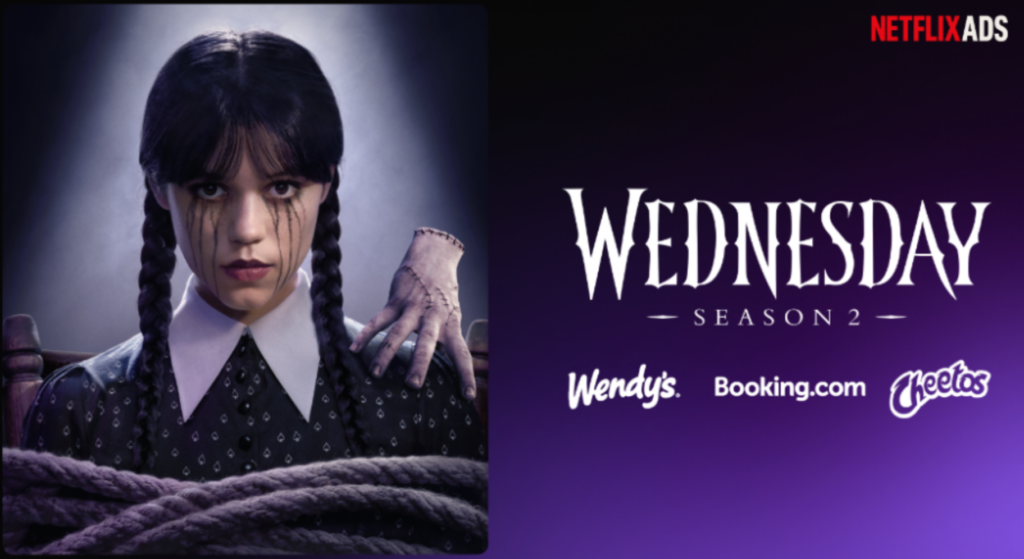
At Netflix’s 2025 Upfront, the company announced AI-powered modular ad formats that place brands directly within the aesthetic world of shows like Stranger Things, Wednesday, and Emily in Paris.
Using AI, Netflix instantly combines product imagery with the visual style of a show. A bag of Cheetos can appear styled to fit the gothic aesthetic of Wednesday. Travel brands can be rendered into the Parisian streets of Emily in Paris, etc.
Results:
- 94 million monthly active users on ad-supported tier
- 8X higher brand favorability vs CTV average
- 162% higher sales per impression vs CTV average
- 3X higher purchase intent vs CTV average
Netflix has already been busy working with shows to place products and ads. This takes it to a new level with generated ads that adapt on the fly. It sets a new standard for generative advertising that can insert itself directly into user experiences.
Why it worked:
Netflix solved the problem of offering brands the impact of product placement without a huge lead time and price tag. AI handles the technical integration while human creatives ensure brand safety and aesthetic fit.
What you can learn:
You can achieve similar objectives by using AI to adapt your products, logos, and other marketing assets for different use cases. Suppose you’re running a Halloween campaign. AI can help you generate themed assets to accompany that aesthetic, incorporating your brand style while adapting to the theme or setting.
2. Spotify: Turning Data Into Social Currency
Spotify Wrapped is the annual marketing phenomenon that turns listening data into shareable stories. Since launching in its current form in 2015, it’s generated billions of social media impressions and turned users into brand ambassadors.
Results:
- 225 million monthly active users engaged (2023)
- 2+ billion social media impressions (2023)
- Creates hundreds of millions in free advertising annually
- 2024 sentiment dropped: 50.5% positive → 41.5% positive (nearly doubled negative sentiment)
While hugely successful, 2024 showed the risks. Spotify leaned heavily on AI-generated content, including AI podcast-style recaps that users found robotic and impersonal.
In 2025 and 2026, the company corrected its course. The design returned to something more authentic and human, while AI was used selectively to generate content from the data.
Why it worked (and why it sometimes didn’t):
Wrapped feels personal, making it a tradition for users to post their results on social media. People want to show off what they’re listening to and align it with their identity. AI has made Wrapped increasingly personalized, generating more granular, detailed results for smaller user segments.
What you can learn:
If you’re sitting on customer data, you’re sitting on shareable content (subject to data usage laws and regulations). You can anonymize data to create first-party reports, articles, and round-ups, too. This applies to both B2C and B2B businesses.
3. L’Oréal/Maybelline: Breaking New Ground with Virtual Influencers
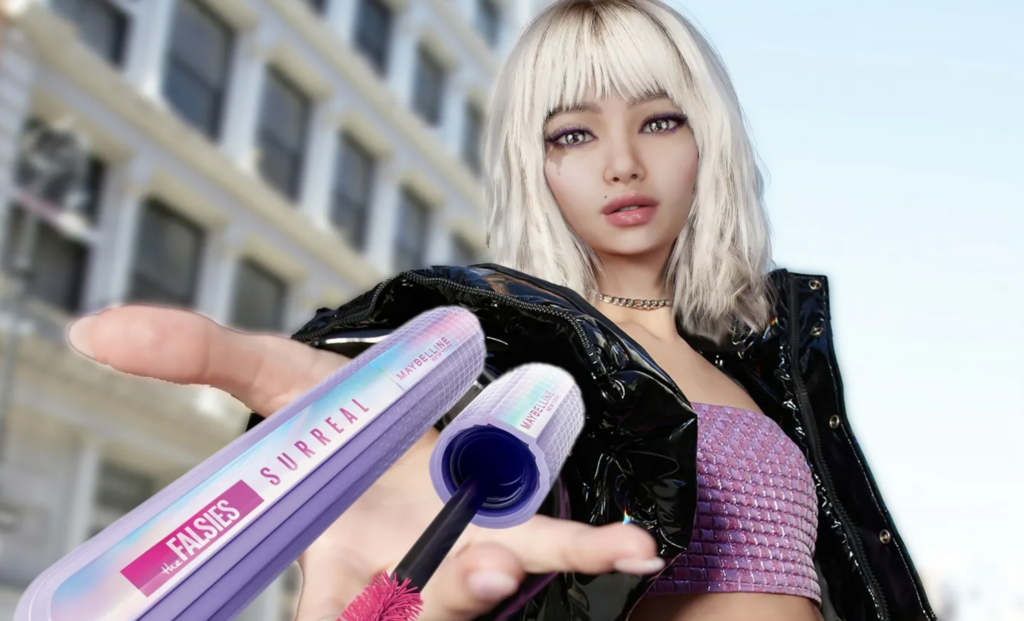
In February 2023, Maybelline launched its first digital avatar, “May,” for the Falsies Surreal Extensions Mascara campaign. May appeared alongside real-world ambassador Gigi Hadid and continues to support future campaigns, virtual product releases, and metaverse activations.
The timing was key. Parent company L’Oréal had just faced “LashGate,” where influencer Mikayla Nogueira was accused of wearing false lashes while promoting a different L’Oréal mascara. Maybelline’s response was to lean into virtual influencers, offering complete creative control without the unpredictability of human partnerships.
Results:
- 58% of people now follow at least one virtual influencer
- 35% have purchased something promoted by a virtual influencer
- L’Oréal cut campaign timelines from weeks to hours using CREAITECH lab
- Content creation speed increased
More recently, L’Oréal has also pushed boundaries with its CREAITECH lab, using Google’s Imagen 3 and Veo 2 to generate marketing content at scale. The company can now instantly customize imagery for different markets.
Why it worked:
Virtual influencers offer consistency, control, and scalability. May can appear in unlimited content without scheduling conflicts, creative disputes, or reputational risk. For a brand moving at L’Oréal’s scale – across 150 countries and 34+ brands – that matters.
What you can learn:
Virtual influencers have become standard today. If your influencer strategy is limited by budget, geography, or availability, they offer an alternative. Audiences accept virtual influencers when they’re clearly synthetic, less so when they’re trying to pass as human. Use them for brand storytelling, not product testimonials that require trust.
4. Nike: Serena vs Serena—When AI Tells Stories Humans Can’t
Nike partnered with AKQA to create a tennis match between Serena Williams from 1999 and Serena Williams from 2017.
The “Never Done Evolving” campaign used AI and machine learning to model each era’s playing style – decision-making, shot selection, reactivity, recovery, and agility – based on archival tournament footage. Building on Stanford University’s vid2player technique, Nike generated 130,000 games and 5,000 matches.
Nike’s campaign is a few years old now and one of the earliest examples of AI in marketing. The final gameplay was broadcast on YouTube to 1.69 million subscribers.
Results:
- 1.69 million YouTube livestream viewers
- 1,082% increase in organic views compared to other Nike content
- Broke all Nike organic views records on YouTube
- Won Grand Prix for Digital Craft at Cannes Lions 2023
Why it worked:
The campaign honored Serena’s retirement with a tribute that felt earned, not gimmicky. AI was used to unlock a creative concept that traditional production couldn’t deliver. The storytelling remained human, while the execution was made possible with AI.
What you can learn:
Use AI for concepts that are genuinely impossible otherwise. Historical comparisons, data visualizations at scale, or simulations that would cost millions to produce traditionally are where AI shines.
5. Heinz: Proving Brand Dominance Through AI
Heinz asked, if we ask AI to draw ketchup, what happens? Working with Rethink Canada, Heinz used DALL-E 2 – which wasn’t publicly available at the time – to generate images from prompts like “ketchup scuba diving,” “Renaissance ketchup bottle,” and “ketchup in outer space.”
Every image looked unmistakably like Heinz, who turned this into social content, limited-edition bottles, print ads, and even art galleries in the metaverse. They invited fans to submit their own prompts, creating social media engagement.
Results:
- 1.15 billion earned media impressions globally
- 38% higher engagement rate than previous campaigns
- 2,500% ROI compared to media investment
- Coverage from Fast Company, Bloomberg, TechCrunch, Forbes
- Won multiple awards, including Cannes Lions
Why it worked:
Heinz is synonymous with ketchup, and they retained their iconic imagery despite going wild with their AI creations. It was humorous and showcased Heinz as a time-tested brand that feels both modern and timeless.
What you can learn:
Rather than using AI to invent something new, Heinz used it to reinforce their brand. They already own the strongest visual and cultural association with ketchup. The experiment simply demonstrated that dominance in a new way.
6. Coca-Cola: The Risks and Rewards of AI at Scale
Coca-Cola has been one of the most aggressive brands experimenting with AI in social content. The results have been mixed.
In 2023, Coca-Cola launched “Create Real Magic,” a platform built with OpenAI that lets digital artists generate artwork using DALL-E and GPT-4. The platform attracted creators globally and positioned Coca-Cola as an AI innovator.
But in 2024, Coca-Cola’s AI-generated remake of its iconic 1995 “Holidays Are Coming” campaign drew fierce backlash. Created by three AI studios using multiple generative models, the ad featured stilted human faces and trucks with wheels that spun in the wrong directions.
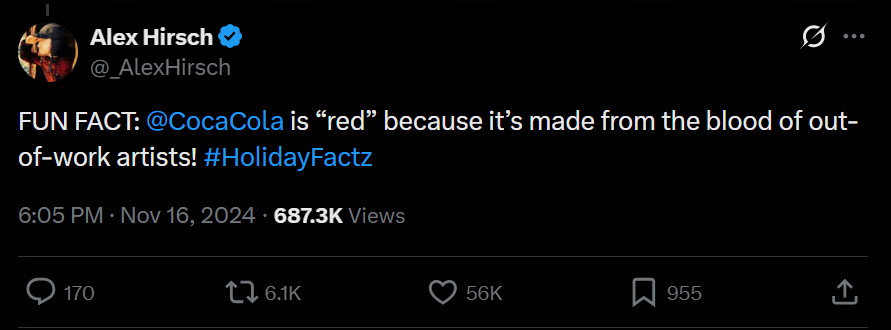
Animator Alex Hirsch’s viral tweet – “Coca-Cola is red because it’s made from the blood of out-of-work artists” – captured the sentiment.
In 2025 and 2026, Coca-Cola tried again, and as technology improves, it looks better but continues to polarize.
Results:
- 5 AI specialists replaced 50-person production crews
- Generated 70,000 clips in 1 month (vs 12 months traditionally)
- Production costs reduced by an estimated 90%
- 2024 campaign: consumer opposition 49% → 2025: 46%
Why the results were mixed:
Coca-Cola gained faster turnaround, lower costs, and infinite versioning for different markets. However, it didn’t fit the Christmas theme. Holiday campaigns traditionally succeed when they feel warm, nostalgic, and human. But as the adage dictates, ‘any publicity is good publicity,’ and Coca-Cola’s revenues continue to climb.
What you can learn:
If you’re going to use AI for emotionally charged content, test extensively before launching. Coca-Cola has the brand equity to weather backlash; smaller brands don’t. Use AI where it adds clear value, but keep emotional storytelling in human hands whenever possible.
7. Burger King: The Million Dollar Whopper
In February 2024, Burger King launched one of the most interactive AI campaigns in fast food history: the Million Dollar Whopper Contest.
Customers could design their dream Whopper using up to eight ingredients through the BK App or a microsite. Once submitted, an AI companion named “Grilliam” generated a photorealistic image of the custom burger and a personalized jingle.
Users could share both assets on social media. They engaged food influencers to create buzz around the campaign. Three finalists would have their burgers sold in stores for a limited time. The winner received $1 million.
The campaign was built on fine-tuned Stable Diffusion, LLMs, and dynamic audio generation, all hosted in a private cloud environment to ensure data security and content control.
Results:
- 14 million BK app visits
- 3 million custom Whoppers created
- 1.3 million AI-generated video ads shared on social
- Record-setting November 2024 in-store sales
- Winner announced January 2025
Why it worked:
The campaign reinforced Burger King’s 50-year-old “Have it your way” promise using modern technology. It was interactive, shareable, and fun. The AI-generated images and jingles weren’t perfect, but they didn’t need to be for people to share their creations, like rainbow buns, gummy worm toppings, and ice cream burgers. Since the subject matter wasn’t serious, people didn’t criticize AI’s usage.
What you can learn:
If you can turn product customization into a contest with AI-generated assets, you create shareable moments that feel personal. The key is making participation easy and the output immediately social-ready. BK didn’t suffer from criticism for this, as the fun-factor was dialled up to the max.
8. Nutella: Making Mass Production Feel Personal
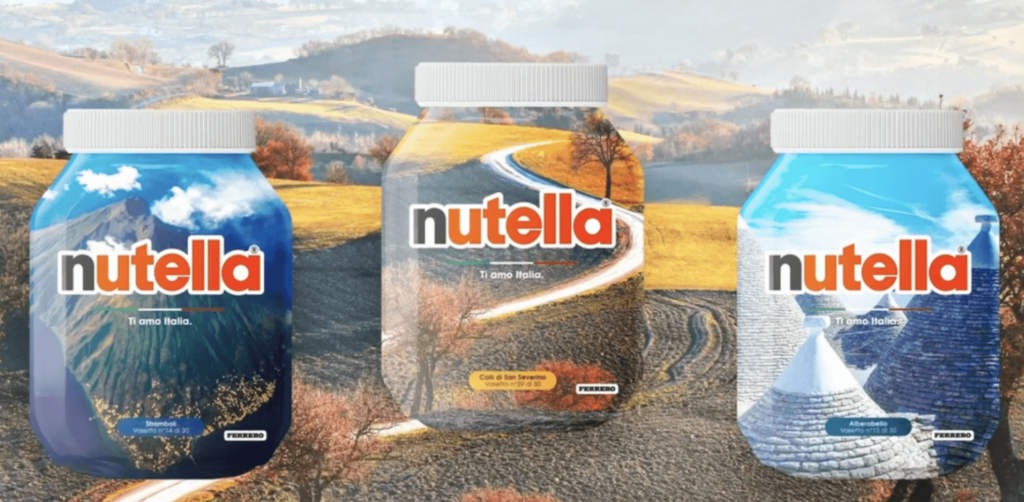
Similar to the Heinz campaign, Nutella launched an AI-driven campaign in Italy to create 7 million unique jar labels.
Working with Ogilvy & Mather Italia, the company behind Nutella, Ferrero used a custom design algorithm to combine dozens of patterns and colours into completely distinct label designs, each with its own identifiable code. The limited-edition jars were treated like collectible pieces of art, and all seven million sold out in about a month.
Results:
- 7 million unique jar designs generated
- 100% sellout rate (every jar sold)
- Over 10,000 organic social media posts from customers
- Customers became micro-influencers without prompting
Why it worked:
Scarcity drives demand. When customers know their jar is one-of-a-kind, they’re more likely to buy, share, and keep it as a collectible. The AI-generated designs required no manual design work, making the campaign economically viable at a massive scale.
The social proof was organic. Customers became micro-influencers, posting unboxing videos and photos without any prompting beyond the unique packaging itself. It helped that the designs were genuinely beautiful too.
What you can learn:
If your product is mass-produced, AI-generated variations can make it feel special. Limited editions, seasonal releases, or regional variants can all be personalized at scale using generative design. The packaging becomes the campaign – customers do the marketing for you.
What You Can Learn
All of these examples showcase AI’s usefulness in unlocking creative concepts that were previously unviable in terms of practicality, cost, or creativity. They show a willingness to take risks and think out of the box.
They also demonstrate boundaries. When the audience strongly expects human involvement and can readily identify AI as a campaign issue, they tend to react.
Here are five key takeaways:
- Use AI to unlock the impossible, not just speed up the mundane: The best campaigns are often ideas that couldn’t exist without AI.
- Know when human touch is non-negotiable: Audiences have a sixth sense for when AI crosses the line, especially with personal stories or cultural moments.
- Be transparent when it matters, invisible when it doesn’t: Sometimes AI is part of the creative concept; other times, it should stay behind the scenes.
- Test, measure, and iterate rapidly: AI makes it cheap to create multiple variations – use that advantage to learn what resonates.
- Stay ahead of the backlash: AI fatigue is real, and what feels fresh today might feel lazy tomorrow.
Want to learn more about creating effective, ethical AI-powered campaigns? Register for our upcoming Virtual AI for Marketers Summit!