When it comes to AI adoption in marketing, access stopped being an advantage a while ago. Your team, your competitor’s team and the startup down the street are all running on roughly the same frontier models, often through the same handful of tools.
So why are some marketing organizations running agents in production while others are still on pilot number six? That was the question behind the Day Two keynote panel at the AI for Marketers Summit, The Gap Is Widening: What Separates Marketing Organizations Winning With AI From Those Still Piloting. On the panel:
- Kaare Wesnaes, Head of Innovation, North America, Ogilvy
- Kuber Sharma, Sr. Director, Product Marketing, UiPath
- Neena Pandey, Global Head of Partner Marketing, Informatica
Moderating the conversation was Katelyn Brower, Director of Public Relations, Social Media, and Events at First Advantage.
The short version: the gap in marketing AI adoption has almost nothing to do with technology. Here’s what stood out.

What Successful AI Adoption in Marketing Looks Like Right Now
Katelyn opened by asking each panelist where their organization sits today. The answers set a useful benchmark for anyone wondering how far behind they are.
Kuber has watched AI rebrand itself several times over his career – machine learning, deep learning, neural networks – and admitted every wave felt real while he was in it. This one is different, he said, because the outputs are finally “good enough to use in real work without significant correction or oversight.”
His product marketing team now runs 10+ active AI agents across research, messaging and content workflows. Two of them have names and have cleared an internal benchmark that makes them, in effect, employees. But he was candid that half of those agents took many tries to get right, and that the real bottleneck sits after the AI is done.
“That gap between what the AI has produced and what we are willing to put our name on is still longer than it should be,” he said. In other words, the technology has moved faster than the judgment process around it.
From Solo Founder to Global Agency
Neena described two very different realities. In the businesses she has founded, AI isn’t an experiment – it’s how a single person covers sales, service, marketing and speaking at once. She has built what she calls a “brain clone,” later adding voice and video, and feeds it customer call transcripts to draft proposals. “Still my decision,” she said, “but AI helps me.” Inside large enterprises, she noted, more approvers and constraints mean a much longer life cycle from idea to impact.
Kaare, meanwhile, put Ogilvy’s marketing AI adoption firmly in a scaling phase. A few years ago the focus was experimentation, then it shifted to adoption – getting AI into the hands of thousands of people and building confidence. Now experimentation is a permanent part of the system, running at two speeds: new models and capabilities flow to everyone through WPP Open, the company’s AI platform, while a vanguard of innovation leads gets permission to push the frontier and bring learnings back.
The Real Advantage Is Organizational Absorption
So if everyone has access to the same tools, what separates the leaders in marketing AI adoption? Kaare’s answer was a phrase worth stealing: organizational absorption, or “the speed at which an organization can turn new AI capabilities into changed behavior at scale.”
The gap, he argued, comes from everything that happens around the technology:
- Do people know how to use it, and do they have permission to experiment?
- Are leaders actually using it themselves?
- Does governance enable people to work, rather than just listing what they can’t do?
- When someone builds a smart agent or workflow, how fast does it spread to every other pocket of the organization?
In fact, that last point is where a lot of teams quietly lose. Without a way to share what works, everyone ends up reinventing the same thing in parallel. “The advantage isn’t just having the best AI,” Kaare said. “It’s how quickly can you turn that technology into changed behavior at scale.”
Pro tip: If you’re building an internal AI program, track how many people reuse a workflow, not just how many build one. Reuse is absorption in action.
Further reading: AI Maturity in 2026: Building and Enabling the Modern Marketing Team
AI Multiplies Strategy – So What Are You Multiplying?
Neena called her take “a little bit unorthodox”: the difference isn’t the tools, it’s the humans. And it comes down to two things.
The first is strategy. “AI is a multiplier. AI doesn’t create strategy,” she said. “So the question is, what are you multiplying?”
Her proof point was a partner campaign with Deloitte. The team started with a list of 8,500 contacts who had good reason to hear from them. A traditional approach would have blasted the full list and banked on a standard conversion rate. Instead, they used AI to narrow it down – not to 2,000, not to 1,000, but to 38 people who had the most urgent need at that exact moment.
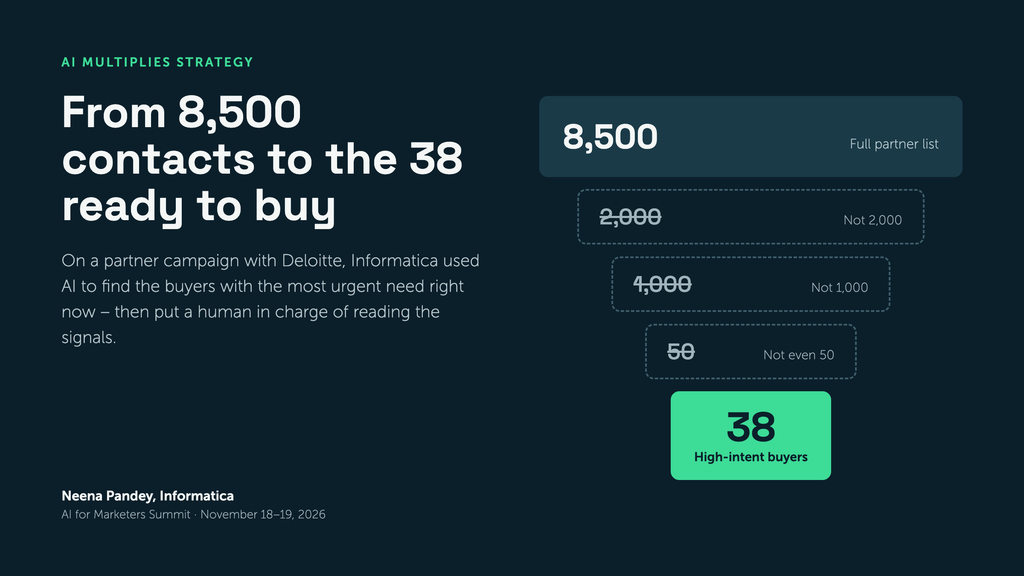
The result was a conversion rate she called “unheard of,” and she was clear about why. It wasn’t the model doing the work. Instead, it was a human reading the signals correctly and pointing the AI at the right problem.
The second is agility. In B2C, she can launch five creatives, keep the top two and kill the rest within days. By contrast, she sees AI adoption in B2B marketing moving far too slowly. Enterprise campaigns come with quarterly reviews, signed-off budgets and, as she put it, “for lack of better words, ego involved.”
AI can surface signals sooner and test alternatives faster, but only people can make the hard call. “If something is not working, then we have to kill it now rather than three months from now,” she said. That willingness is what will separate the companies that succeed from the ones that don’t.
Why Marketing AI Adoption Dies in Week 10
Some marketing organizations have been running AI pilots for years without moving adoption any further. Kuber, whose work includes a framework called The Pilot Trap that maps where marketing AI projects stall, says they get stuck in the same place almost every time: IT, legal, compliance or whoever controls the budget wasn’t in the room when the pilot was planned.
However, the blocker is rarely the executives. “Execs love talking about AI,” he said, likening AI pilots to their version of a water cooler conversation.
He shared a story that will feel familiar to a lot of readers. A team he works closely with built an AI system that synthesized web signals, customer feedback and internal performance data into a tactical, actionable briefing. The pilot ran for a few weeks, everyone loved it, and leadership saw the demo.
Then it needed real access to real CRM and customer support data. IT had never reviewed a data access request for an AI system. Legal wanted to understand what the model would do with customer data before approving – a hard question when you don’t own the model.
The pilot limped along on a workaround, with someone pulling data manually using their own credentials. Eventually, it died. “It wasn’t because AI did not work,” Kuber said. “The AI worked really well, but because the conversations that should have happened in week one happened in week 10.”
The teams that break through bring those stakeholders in to help design the project, not review it at the end. In week one, answer:
- What are the data access requirements on day one?
- What does the vendor approval process look like, and when does it need to start?
- What does legal need to see before this touches customer data?
“As marketers, we usually do have answers early on,” he said. “We just don’t kick off the process early on.”
Measure Usage, Not Just Accuracy
Kuber also flagged a measurement trap. Most teams judge pilots on whether the AI works. That’s a pilot-level question. The production-level question is whether people will actually use it – he’s seen tools with high accuracy rates that almost nobody opened six months later.
Katelyn added her own go-to advice here: build a cross-functional AI task force from day one, so those questions get answered before the pilot ends.
Scaling AI Adoption in Marketing Starts With the People Closest to the Work
How do you spread AI skills beyond a small group of experts? Both Kaare and Kuber pushed back on the idea that the answer is more training.
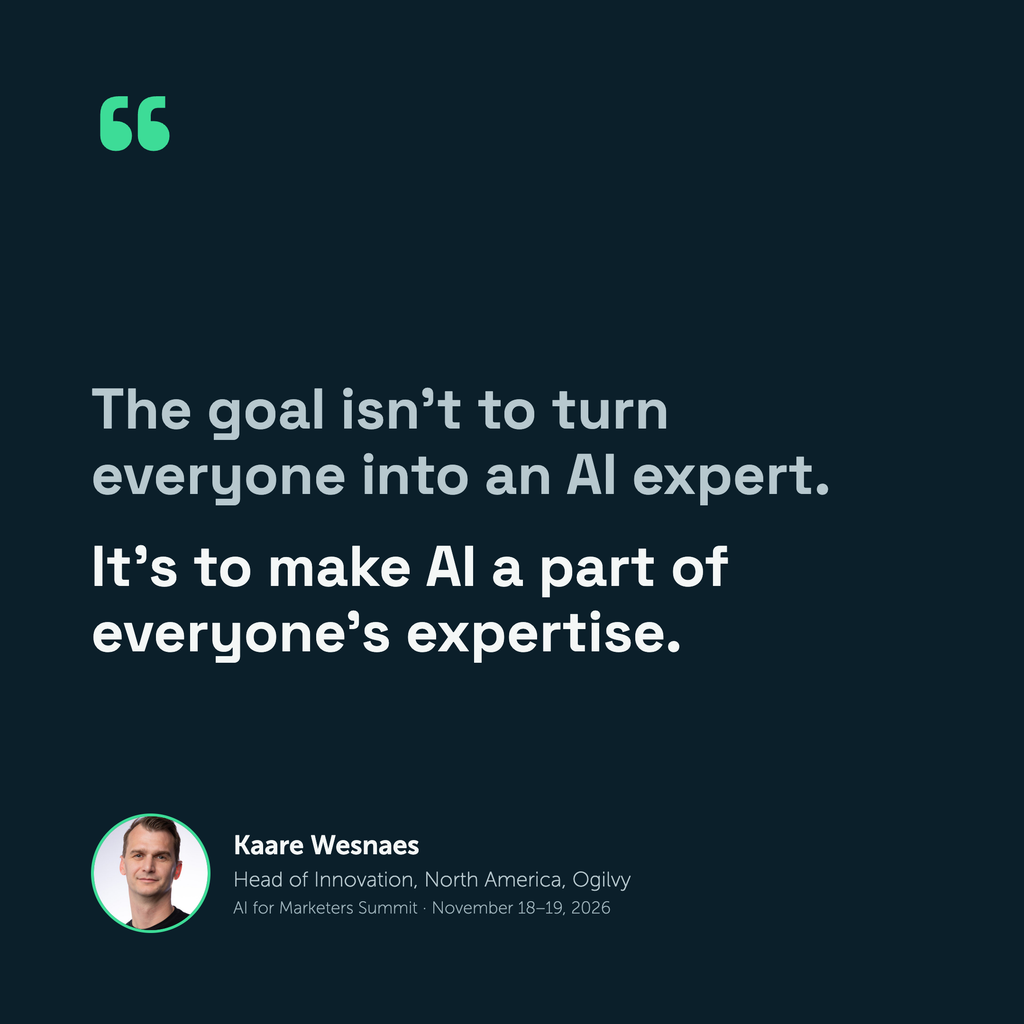
For Kaare, democratization is an innovation strategy, not a training strategy. “The goal isn’t to turn everyone into an AI expert,” he said. “It’s to make AI a part of everyone’s expertise.”
A strategist understands their workflow better than any innovation lead. So does a creative, and so does a producer – and each will spot different opportunities. Ogilvy’s approach is to give people enough fluency, tools and permission to find those opportunities themselves, then back them with AI champions in every group who help the best ideas become real and spread them across North America.
The payoff has surprised even him. People who would never have described themselves as technical are now building complex agents – from back-of-house finance work in Excel to front-of-house creative ideas nobody had seen before.
Peer Proof Beats Top-Down Training
Similarly, Kuber’s version came down to a single story. One product marketing manager on his team had zero interest in AI, but was rebuilding the same competitive summary for sales by hand every week. They spent an afternoon on it together, pulled in a couple of teammates who already had AI workflows running at scale, and within a few weeks that PMM had fully adopted it.
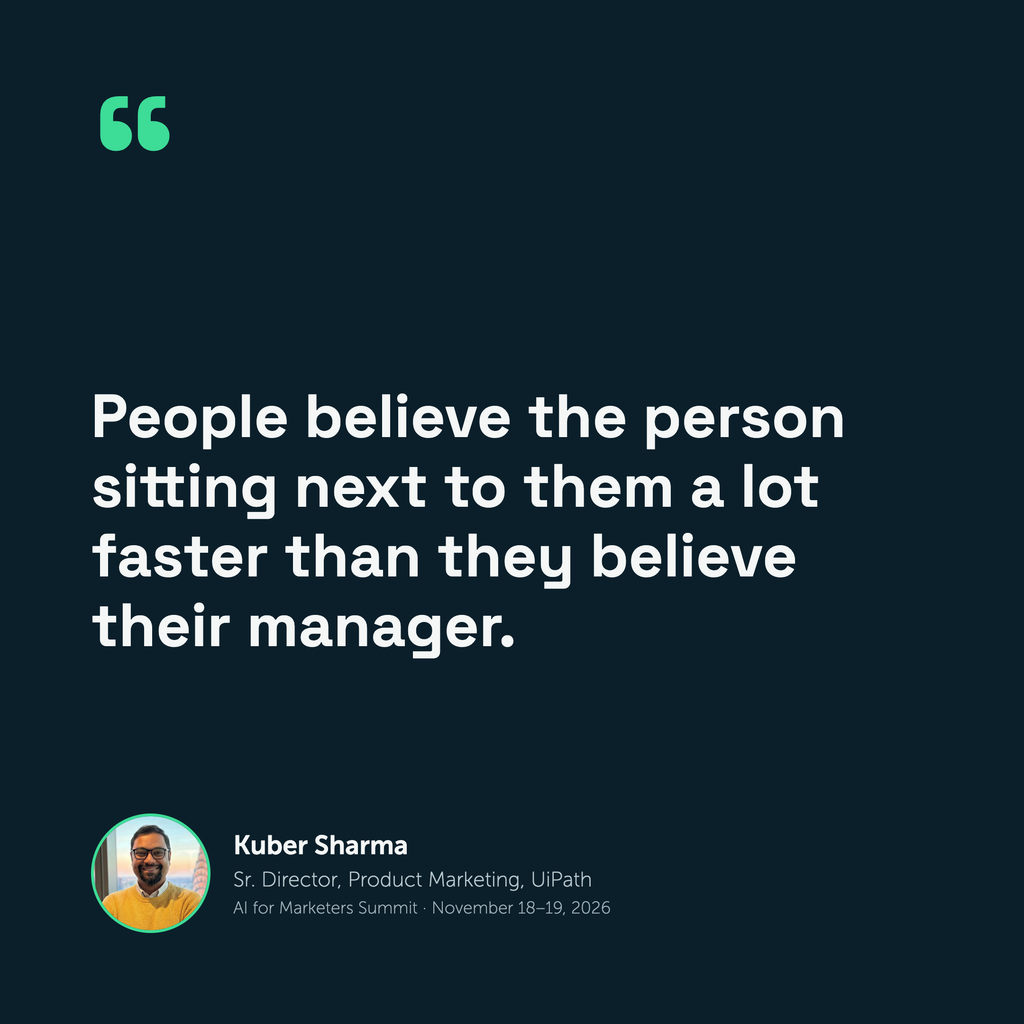
“People believe the person sitting next to them a lot faster than they believe their manager,” he said. “And that’s basically the whole playbook.”
The version he has watched fail – including at UiPath – is a central expert team that builds everything and pushes it out. “You end up solving the problem the expert assumes was there.” Instead, the best uses, he said, come from people who never planned to be “the AI person” until AI solved a real problem for them.
Trust Runs Both Ways: Advise, Don’t Block
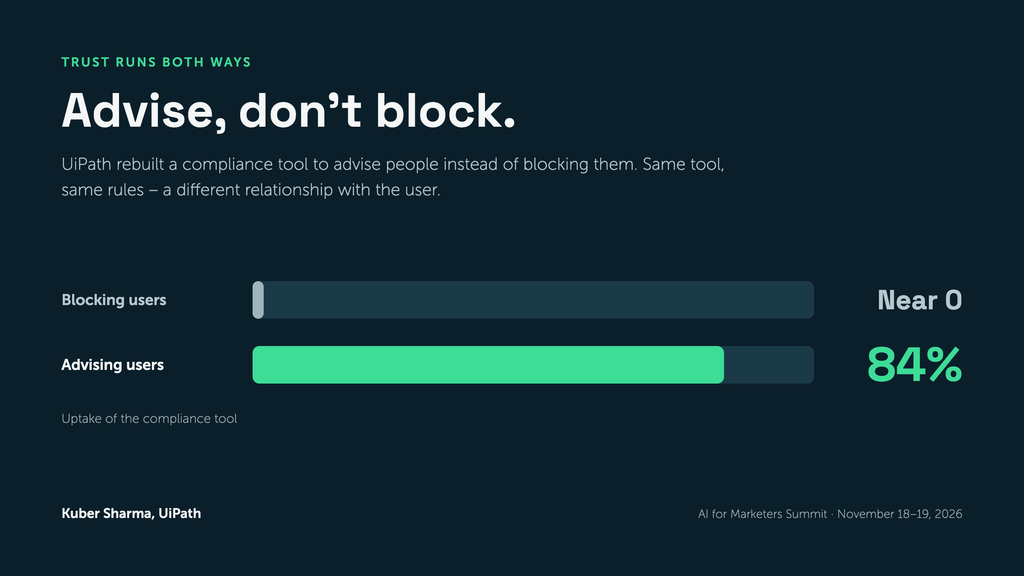
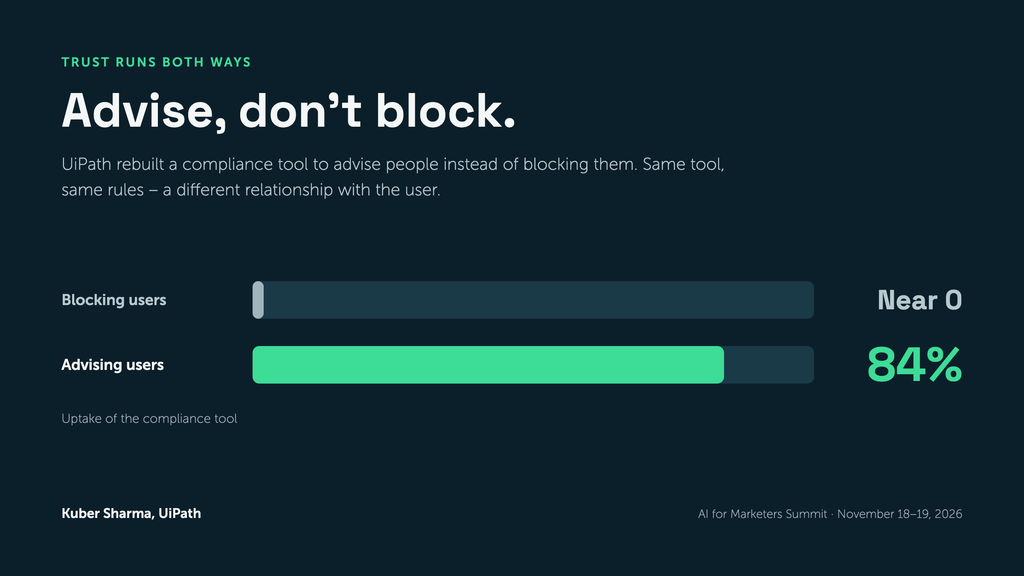
One of the most striking numbers from the session: Kuber’s team rebuilt a compliance tool so it advised people instead of blocking them, and uptake went from near zero to 84%.
His lessons were simple. Serve the customer, work with the experts, and treat AI as a co-pilot “like a friend who’s trying to solve the problem,” not a magic bullet. Next, build alongside users with quick reviews and quick revisions. And again, bring the people whose sign-off you need into the design process so you skip the long, painful review at the end.
Meanwhile, Neena reframed trust entirely. “We ask people to trust AI,” she said. “But do we trust them enough to let AI change how they work?” In her own business she can try something and decide the same day. In a company, the same idea might need three departments and 50 people to approve it.
As a result, her playbook for marketing AI adoption balances freedom with trust:
- Write down the rules. What’s approved, what people can use and what’s off-limits. Then let people be creative inside those lines without asking permission.
- Keep a human on anything that touches a person. She tested this herself by feeding interview transcripts for an open role into AI. Not one of its top three candidates matched her own top three. “AI misses things,” she said.
- Make the value visible. People hesitate when they can’t see the benefit. Showing that a five-hour task now takes one hour does more than any mandate.
- Look across the whole company, not just your team. A marketing tool that costs more but saves money in HR or sales is still a win, so someone needs to own AI outcomes across the entire organization, not only within silos.
One Move to Accelerate AI Adoption in Marketing in the Next 90 Days
To close, Katelyn asked each panelist for one concrete move a marketing leader could make in the next 90 days if their team is still stuck in experimentation.
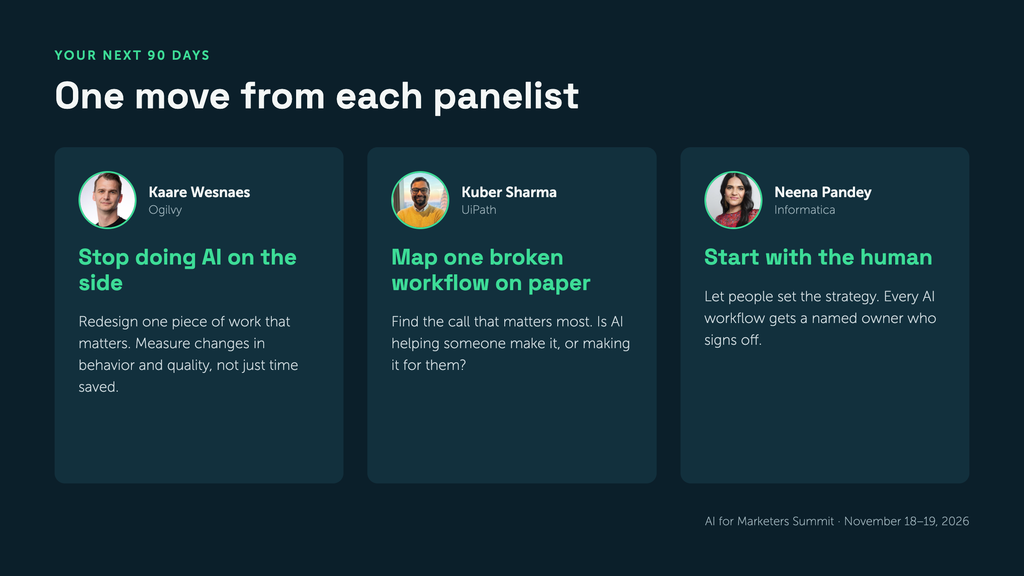
Kaare: Stop doing AI on the side. Pick one piece of work that really matters to the business and treat it as a real redesign, not a sandbox exercise. Give the actual people doing it access, training and permission to change it, and bring governance in from the start. Then measure what changes – and not just time saved. “I mean, look at what the behavioral change is, what is the quality, the outcomes,” he said. “You don’t become an AI-enabled organization by just accumulating pilots.”
Kuber: Map one broken workflow on paper. Choose a workflow you already know is working badly and write down every step. You’ll find a couple that nobody can explain, which is a lesson in itself. Then find the moment where someone makes a call that really matters if it’s wrong, and ask one question: is AI helping that person make the call, or making it for them? “If it’s making the call, adoption is going to stall,” he said. Resist the urge to roll out 10 things for a nice end-of-quarter slide. One workflow doing really impactful work beats ten that don’t.
Neena: Start with the human. Build on the capabilities and marketing fundamentals your people already bring, then use AI to multiply them. Strategy should always come from people, and every AI workflow should have a named owner: “generated by AI, signed off by XYZ.” When people feel valued in driving adoption, she said, adoption takes a very different direction.
The Bottom Line
Every answer on this panel pointed the same direction: the gap between marketing leaders and laggards in AI adoption isn’t about who has the best model. It’s about how fast an organization can turn AI into new habits – with the right stakeholders in the room early, the people closest to the work leading the way, and a human signing off on what matters.
In short, the teams pulling ahead aren’t running more pilots. They’re redesigning real work, one workflow at a time, and letting the results spread.
FAQ
Why do AI pilots in marketing fail to reach production? According to Kuber Sharma of UiPath, it’s rarely the technology. Pilots usually stall because IT, legal, compliance or budget owners weren’t involved from week one, so data access and approval questions surface only after the pilot has ended.
What separates marketing teams winning with AI from those still piloting? Kaare Wesnaes of Ogilvy calls it organizational absorption: how quickly a team can turn new AI capabilities into changed behavior at scale, through permission to experiment, executive use, enabling governance and a way to spread what works.
How can marketing leaders increase AI adoption on their teams? The panel recommended solving real, daily pain points side by side rather than relying on top-down training, designing AI to advise rather than block, and keeping a human sign-off on anything that touches a customer or employee.
What should a marketing leader do in the next 90 days to scale AI adoption? Pick one workflow that matters, map every step, decide where human judgment is critical, involve governance early and measure behavior and quality changes, not just time saved.
Want more sessions like this one? Register for one of our upcoming AI for Marketers events.
Here are some similar articles you might enjoy:
- 8 Tips for Optimizing Your Website for AI Search
- 10 GenAI Prompting Techniques for Marketers
- Top 10 Claude Skills for Marketers in 2026