Two years ago, AI in marketing was mostly a single tab open in someone’s browser. Now, that era is over.
According to Jasper’s State of AI in Marketing 2026 report, 91% of marketing teams now use AI, a sharp climb from 63% the year before.
Adoption is no longer the interesting finding, though. What’s changing now is what marketers are doing with AI – how it’s embedded into workflows, new creative uses, and where bottlenecks reside.
Read on as we discuss how AI-driven marketing is developing, and what’s emerging as marketers move towards systems-level execution.

Beyond The Chatbot
The earliest wave of generative AI in marketing was about productivity at the individual level.
For example: write this email faster, brainstorm 20 headlines instead of 3, summarize a competitor brief in 2 minutes, write a blog draft immediately, etc. Primarily ad hoc, mostly improvised from within the browser.
In 2026, emphasis has shifted to scale, governance, repeatability, and integration. AI has moved from a one-off, individual mode towards repeatable, dependable systems, especially in the following areas:
- Content production: Scaling high-quality output is now the top AI priority among marketers, up 2.4x year over year.
- Campaign execution: 51% of marketers cite faster time-to-market as the top realized AI benefit, more than double the share in 2025.
- Reporting and analysis: Marketers are increasingly building their own cross-channel dashboards and attribution pipelines rather than waiting on a BI team.
- Briefing and review: Reusable brief templates and AI-assisted brand QA are replacing ad-hoc back-and-forth.
There is a big caveat. As per Jasper’s evidence, most teams have access to AI, but few have rebuilt their workflows around it. Breaching the gap between ad-hoc and systematic is tough but rewarding for those who accomplish it.
Agentic Workflows
Agentic AI was always ‘coming soon,’ but it’s now decisively here with tools like Salesforce Agentforce, HubSpot Breeze, Claude Cowork, OpenClaw, and Jasper Agents.
McKinsey’s latest research on agentic marketing workflows puts the productivity ceiling much higher than chat-only AI. Agentic systems will speed up the creation and execution of marketing campaigns by 10 to 15 times, according to their research.
Some key examples of practical agentic workflows:
- Continuous campaign optimization: Agents that adjust bids, swap creatives, and rebalance budgets across channels in real time.
- Always-on competitive intelligence: Agents that monitor competitor sites, ad libraries, and pricing pages, flagging changes and explaining the likely strategic intent behind them.
- Multi-asset content pipelines: Coordinated agents handling the brief, draft, brand QA, SEO, and publishing steps end-to-end.
- Lifecycle email programs: Agents that adapt sequences in real time based on user behavior, replacing the pre-defined branching logic that defined the last decade of marketing automation.
Adweek summed up the strategic stakes in a recent piece, arguing that teams that “run marketing like a relay race between specialized teams” will be outperformed by those running it like “a control room overseeing agentic-AI workflows.”
It’s a good point. AI is becoming embedded, systemized, and omnipresent across workflows – not ad-hoc and used only in a browser.
Programmatic Marketing
Following on from the above, three AI coding platforms have become powerful tools for the marketing toolkit in 2026:
- Claude Code (Anthropic) – terminal-based agent that runs locally on your machine, with deep access to your project context.
- Codex (OpenAI) – cloud-based agent inside ChatGPT, designed to run tasks asynchronously and across parallel sessions.
- OpenClaw – open-source gateway that connects messaging apps (WhatsApp, Telegram, Slack, Discord) to coding agents like Claude Code and Codex. Hit 100,000 GitHub stars in its first week.
The AI marketing community has now met “vibe coding” – the art of using AI to code apps, software, and automated processes using natural language.
You can now spin up a custom report, a data integration, a competitive scraping tool, an automated content workflow, or almost anything else, in much the same way as an image or piece of content.
Some Examples Of Agentic Marketing
A few examples of vibe coding-driven marketing have been doing the rounds in 2026:
- Kamil Rextin (42 Agency) built a LinkedIn-ad-intel agent in Claude Code that pulls a competitor’s LinkedIn ads, summarizes positioning changes, and generates an ongoing intelligence report.
- Hiba Fathima (Firecrawl) built a brand mention tracker in Claude Code that pulls weekly mentions from Reddit, Hacker News, Twitter, and niche forums into a digest she folds back into her content.
- Claire Vo (LaunchDarkly CPO, ChatPRD founder) runs a team of nine AI agents on OpenClaw that handle email triage, content drafts, sales emails, and meeting prep across WhatsApp and Telegram.
- The marketingskills repo on GitHub is a growing open-source library of skills covering landing page CRO, copywriting, SEO audits, email sequencing, and analytics tracking.
With vibe coding for marketing, the floor for what a non-technical marketer can build is rising rapidly. This will likely challenge automation platforms like Zapier, as you can now build far more advanced workflows and pipelines for anything from content creation to report building.
AI Design Tools For Marketers
The same pattern is playing out in visual work. Anthropic’s Claude Design is a cutting-edge AI design tool that turns natural-language briefs into landing pages, decks, social assets, dashboards, and wireframes, and exports them as real, on-brand code.
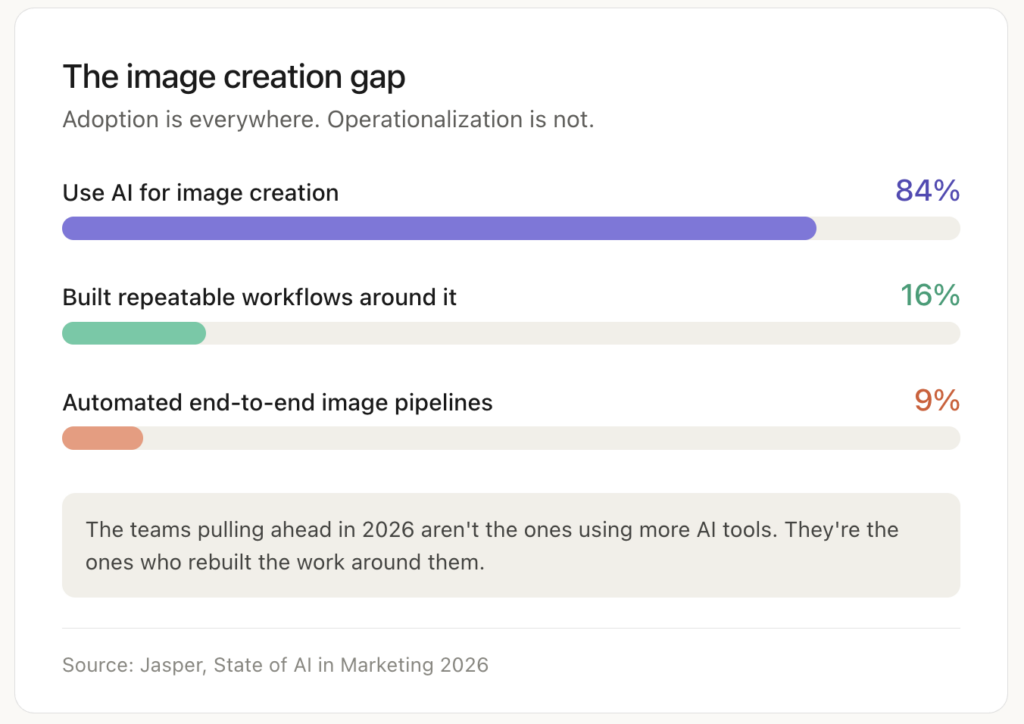
Jasper’s data shows that 84% of marketers use AI for image creation, but only 16% have built workflows around it, and a mere 9% have automated end-to-end image pipelines.
Claude Design is the first into this space, but expect Canva, Adobe, and others to follow. It will soon be possible to build incredibly advanced imagery using AI.
And that doesn’t mean the kind of obviously AI-generated graphics you can create with text-to-image. These are structured, clean, and beautiful.
For marketers specifically, the practical use cases include:
- Prototyping landing pages: Test a concept before involving a designer or front-end developer.
- Building pitch decks: Turn a rough outline into a full deck with on-brand styling.
- Generating campaign mockups: Spin up stakeholder-ready visuals for review without a long design queue.
- Turning raw data into branded infographics: Keep visual reporting consistent with the rest of the brand system.
AI Avatars and Synthetic Spokespeople
Brands now have AI versions of their founders, presenters, and product experts that can shoot infinite content at near-zero cost. In essence, they’re leveraging their own teams as an AI asset.
- Per Gartner, brand adoption of virtual influencers jumped from 60% to 73% between 2025 and 2026. Beauty and personal care leads at 89% adoption, gaming and entertainment at 84%, and luxury fashion at 81%.
- 58% of consumers now follow at least one virtual influencer, and 35% of Gen Z have bought something promoted by one.
Currently, HeyGen and Synthesia are leading in AI presenters and talking-head video, with ElevenLabs leading in voice cloning.
The catch is consumer comfort, because some 46% remain uncomfortable with AI-led brand promotion. Categories where audiences accept it (beauty, gaming, luxury) are getting the green light, whereas trust-sensitive verticals (health, finance) are moving more carefully.
AI Video Hits the Mainstream
Text-to-video has crossed the line for marketing use cases in 2026. The lineup has reshuffled too – OpenAI’s Sora was retired in April, with a fresh selection of models stepping in:
- Veo 3 (Google DeepMind): Integrated into Workspace, YouTube, and Performance Max for ad creative.
- Runway Gen-4: Strong on cinematic shots and motion control.
- Kling 2.x (Kuaishou): Often the highest-rated for realism in independent benchmarks.
- Luma Dream Machine: Fast iteration cycles, popular for social-first campaigns.
- Seedance 2.0 (ByteDance): Launched in February, ships multi-shot sequences from a single prompt or product photo.
AI video is still early, but it’s finding a niche and becoming much easier to control. It’s now possible to build content pipelines across text, images, and video programmatically using OpenClaw, Claude Code, and the tools above.
Marketing Roles Are Being Rewritten
AI is now influencing hiring decisions in concrete ways. Some new roles that are percolating marketing hiring strategies:
- AI Search Specialist (40%): The top planned hire for 2026, focused on visibility in AI-driven search and answer engines.
- AI Transformation Lead (34%): Owns the broader rewiring of marketing operations around AI.
- AI Trainer / Prompt Engineer (31%): Upskills the wider marketing team on prompting and tool use.
- AI Architect (31%): Designs the underlying systems, integrations, and agent workflows.
- AI Ethics & Compliance Lead (28%): A role that didn’t exist in most marketing orgs two years ago.
- Content Engineer (19%): Owns the content production pipeline end-to-end.
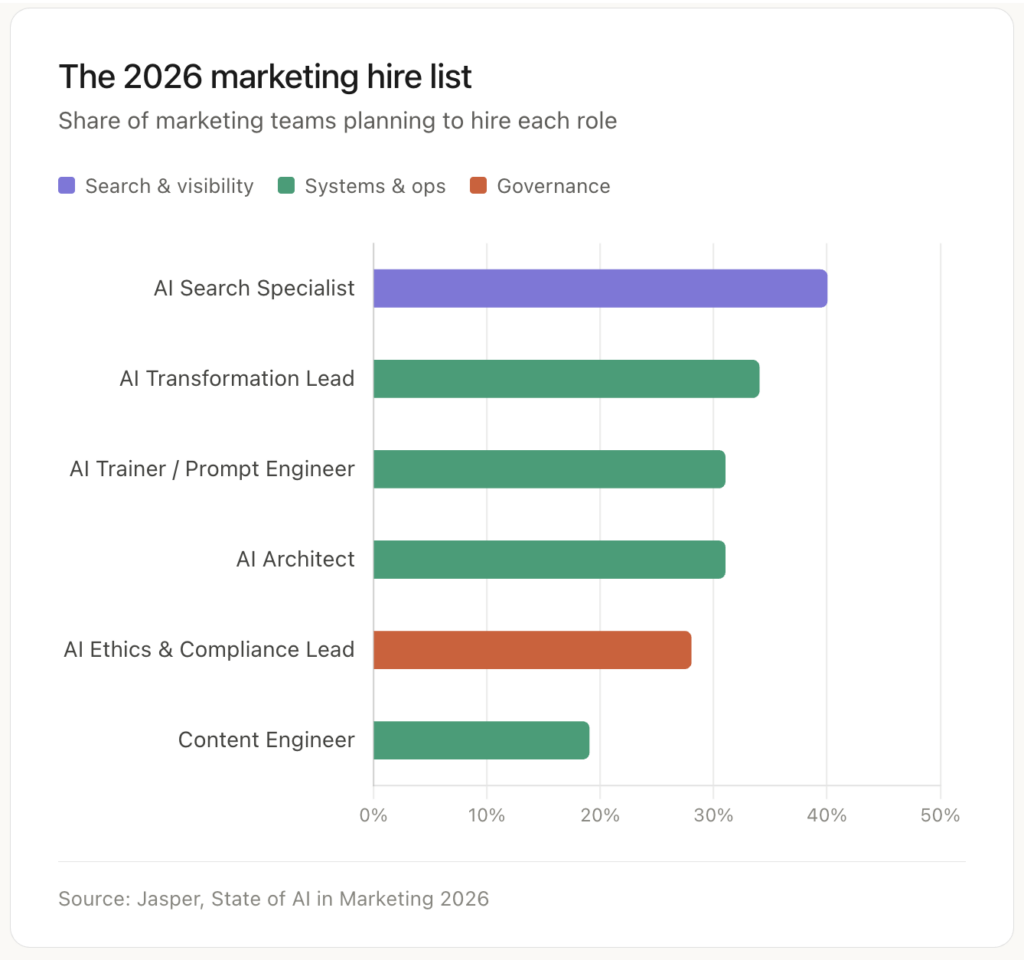
Taken together, these roles signal a more technical, systems-oriented marketing function. Most of them didn’t exist as defined positions two years ago, and they all sit closer to ops, engineering, and compliance than to traditional brand or campaign work.
By the end of the decade, the marketing org chart will look more like a small product team than the channel-led marketing department of 2020 – and the marketers building careers in 2026 are the ones already moving in that direction.
Where Is AI Marketing Heading Next?
It’s clear that AI marketing is moving from ad-hoc and experimental to embedded and systematic. Learning to use AI well within self-contained tools is one thing. Stringing tools together into consistent workflows is the next level.
There are some technical barriers to building fully programmatic, agentic workflows, but these are eroding with the likes of Claude Code and Claude Design. A deeper level of sophisticated workflows awaits those who familiarize themselves with these tools today.
The simplest practical next step for most teams is to pick key workflows – content production, research, reporting, creative – and begin to systemize them as repeatable, scalable processes.
The next deep dive happens live at our upcoming AI for Marketers Summit, with sessions on operationalizing AI – agentic workflows, governance, custom tooling, and what’s delivering impact for marketing teams right now.