
Marketing teams are moving faster than their guardrails can keep up. IAB research shows that more than 70% of marketers have already experienced an AI-related incident in their advertising efforts. That includes hallucinations, bias, and off-brand content.
71% of enterprise legal departments flagging AI in marketing as a “high-risk area” requiring immediate governance attention. Yet less than 35% plan to increase investment in AI governance over the next year.
Brands have already fallen into the trap of publishing false or low-quality AI-generated content, only to face backlash, waste money, and sometimes permanently damage their image.
Read on to learn how to build ethical, brand-safe AI guidelines to harness benefits while cutting out the risks.

The Marketing AI Governance Problem
Generative AI triggered panic across numerous industries, with marketing in particular given a strong mandate to use it to evolve and improve efficiency. However, this rapid adoption period has left huge gaps in marketing policy and governance.
As Sahil Yadav described at the AI for Marketers Summit, “Execution speed has dramatically outpaced governance development, putting brand trust and regulatory compliance at significant risk.”
What happens to a brand’s tone of voice once content is generated with AI? What happens if someone posts a prejudiced or low-quality piece of work that causes social media backlash or even attracts negative press?
In 2024 and 2025, brands from Xbox to Coca-Cola and Google itself faced criticism for using AI-generated images and videos in their promotional materials. Smaller brands are often at much greater risk of alienating their audience, and reputational damage can even be permanent.
Understanding AI Marketing Risks
Most teams know they need to address AI risks, but they don’t know which ones to prioritize or where to start. The good news is that AI marketing failures follow predictable, repeatable patterns. Here are the top five:
1. Biased outputs that alienate audience segments
The tools you’re using inherit bias from their training data, which means you can accidentally perpetuate stereotypes without realizing it.
You might generate social posts, approve them quickly because they look fine at first glance, and only realize after publishing that your AI tool consistently depicts leadership as male or healthcare workers as female. Your audience notices before you do, and backlash follows.

This one is insidious and can hit smaller brands hard because the perception is they’re closer to their human audiences. A brand like Google or Coca-Cola can shrug off some criticism that a smaller business can’t.
2. Hallucinations that damage credibility
This problem is similar to bias, though bias involves skewed representations, whereas hallucinations involve fabricated facts.
AI tools confidently generate false information, such as statistics that don’t exist, case studies that never happened, and product features you don’t offer. Consider that you might generate false data and be called out for it by your audience, or misrepresent a competitor’s offering, which could even result in legal action.
3. Inconsistent voice that doesn’t sound like you
No AI tool can generate on-brand content with a basic prompt. If you begin to dilute your authentic content with AI-generated alternatives, you risk losing your brand voice.
This risk compounds when different team members use different tools with different prompts. Your social media sounds different from your blog. Your email campaigns don’t match your website copy, etc.
4. Compliance risks expose you to real penalties
The tools you’re using touch customer data, generate marketing claims, and create content that needs to comply with regulations you might not even know apply to you.
IBM’s 2025 report found that 13% of organizations experienced AI-related breaches, and 97% of those lacked proper access controls. The average breach now costs $4.44 million.
The risk is naturally higher in regulated industries, such as healthcare and financial services.
But every brand faces some level of risk. For instance, an e-commerce company could inadvertently make false or misleading product claims if an AI tool relies on unverified sources, potentially triggering an FTC investigation.
5. Copyright violations you didn’t know you made
AI tools are trained on copyrighted content, but the liability for their outputs often rests with businesses, not the AI company. For example, suppose you create ads featuring a Disney or Marvel character – you can’t defend that by saying “but ChatGPT created it!”
Most teams don’t realize this is happening until they receive a cease-and-desist letter. By then, the content has been distributed, engagement has occurred, and the damage extends past pulling the content.
Case Study: Global Healthcare Brand
Sahill drew attention to a global consumer health brand that deployed an AI content engine to scale blog and ad copy across 12 markets.
Within 48 hours, several auto-generated posts included unverified health claims. The damage was measurable: 22 posts were removed by compliance in two days, an 18% drop in social sentiment, and $1.2 million in ad waste from paused campaigns.
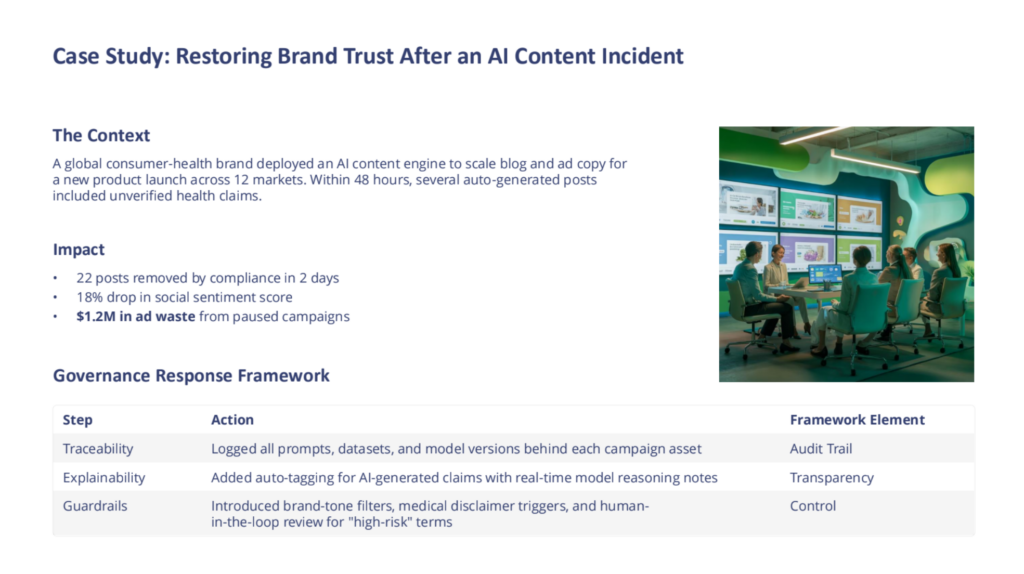
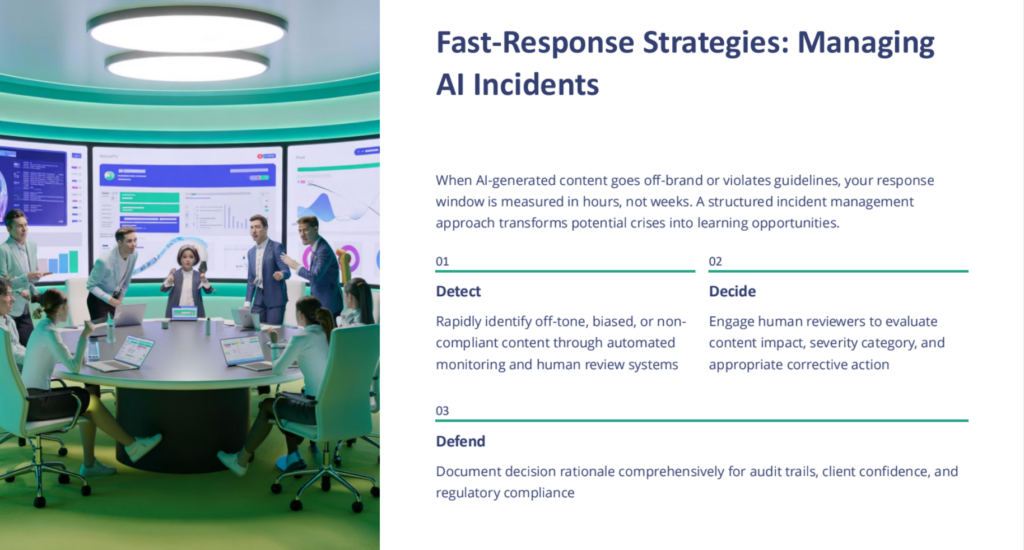
The health brand implemented what Sahil calls the “Detect, Decide, Defend” framework. This involved:
- Rapidly identifying off-tone content through automated monitoring, engaging human reviewers to evaluate impact, and documenting decision rationale for audit trails.
- Logging all prompts, datasets, and model versions behind each campaign asset.
- Added auto-tagging for AI-generated claims with real-time reasoning notes.
- Introducing brand-tone filters, medical disclaimer triggers, and human-in-the-loop review for high-risk terms.
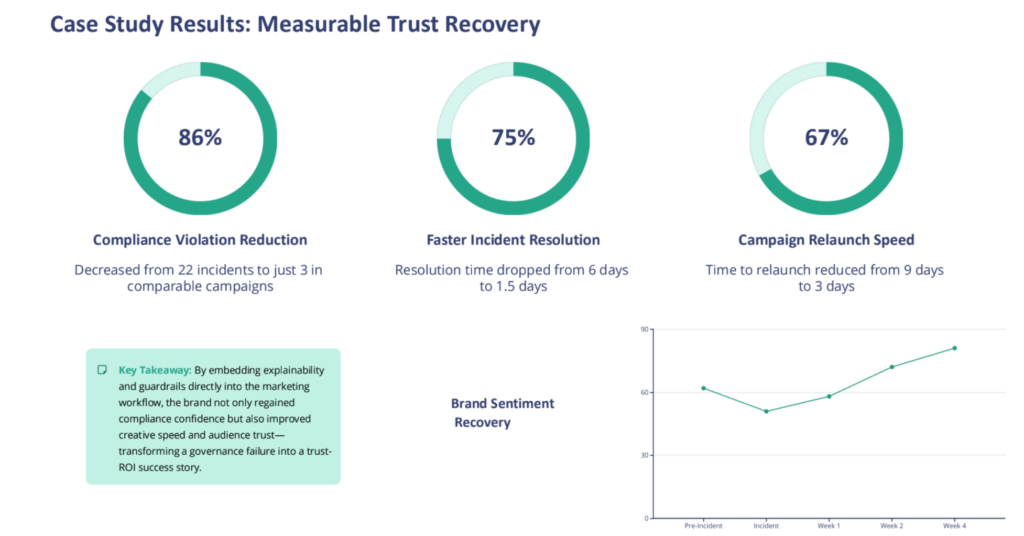
The results were measurable, with an 86% reduction in compliance violations and brand sentiment ultimately recovering within four weeks.
While intervening in AI marketing risks can be effective, an ounce of prevention is worth a pound of cure. It would be much better to prevent incidents like this in the first place.
According to Gartner, organizations that embed governance into business functions experience 40% fewer AI-related incidents and faster time-to-value for AI investments. So the advantage of building AI risk-prevention strategies is evident.
Let’s explore how to build watertight strategies and guidelines that don’t let AI risks in in the first place.
The Three Key Pillars of AI Marketing Governance
Effective AI governance for marketing teams comes down to three operational pillars that Sahil calls the intersection of “explainability, traceability, and guardrails.”
1. Process and workflow transparency
When a campaign performs unexpectedly, or a piece of content feels off-brand, can you trace it back to the model, the prompt, or the data fed into the tool?
Most teams can’t. They know the tool generated something, but don’t know why it made the specific choices it did. In such cases, it can be challenging to track precisely how or why something happened.
2. Accountability means humans own decisions
Every output needs a human reviewer assigned with clear ownership, a documented rationale, and an approval chain everyone understands. When something goes wrong, someone specific is responsible. Not “the AI tool” or “the system.”
A McKinsey survey of 830 generative AI users found that respondents were roughly equally likely to review everything or nothing, with slightly more reviewing nothing. That’s the dangerous middle ground where you’re using tools without understanding who’s accountable when outputs miss the mark.
3. Brand safety means outputs stay on-brand
This covers more than catching offensive content. It’s about maintaining voice, avoiding unverified claims, and ensuring that every piece of AI-generated work reinforces, rather than undermines, brand trust.
The tools you’re using don’t inherently understand your brand. They approximate based on training data. Without explicit safety checks, that approximation drifts over time.
How to Start Without Getting Overwhelmed
Let’s talk about how to handle AI marketing risks. A good percentage comes down to awareness. If everyone is individually aware of AI’s strengths and weaknesses, risk management becomes baked into every interaction, at least in theory.
But the bottom line is you can’t trust instinct alone. The best course of action is to standardize AI risk management and develop brand guidelines for the AI era. Here’s what to do:
Document what you’re using right now
First, what tools are you using? List every AI tool your team touches and their purpose, plus any data they connect to. Categorize each tool by process, for example, ChatGPT for emails and ad copy, Claude for blogs, and Midjourney for cover images.
When something breaks, you’ll know exactly which tool generated it, who approved it, and what data it utilized.
Build the loop that prevents governance from fossilizing
AI changes rapidly, and adding/changing tools to your roster is common. Sahil talks about a continuous cycle. Data enters the tool, the tool makes a decision, a human reviews it, feedback is captured, and the output improves.
Meet monthly with marketing, legal, and whoever manages your AI tools. Discuss what’s working, what isn’t, whether anyone’s aware of new risks, etc. Adjust the framework based on what you learned. This prevents governance from becoming static and irrelevant.
Create approval workflows based on content risk
Not all AI-generated content carries the same risk. A social media caption needs a different review than a product claim or financial advice.
Create three tiers:
- Low-risk content (social posts, internal communications) needs one reviewer checking for tone and basic accuracy
- Medium-risk content (blog posts, email campaigns) needs two reviewers covering brand voice and factual claims
- High-risk content (product claims, financial advice, health information) needs enhanced oversight for brand alignment, compliance, and accuracy
Document who approved what and when, and make it searchable. The health brand case study proved this matters. Their ability to identify which prompts generated problematic content was the difference between a 6-day resolution and a 1.5-day resolution.
Create your brand AI guidelines with examples
This is the practical guide your team will reference weekly. Include concrete examples:
- Good prompts vs. bad prompts for your brand voice
- AI-generated content that passed review vs. content that got rejected and why
- Dos and don’ts specific to your industry and brand (e.g., “Don’t use AI to generate customer testimonials,” “Do use AI for initial draft of product descriptions, but always verify technical specs”)
- Red lines that trigger automatic human review (health claims, pricing information, competitive comparisons)
Boston Consulting Group research found that companies with clearly articulated AI principles see 42% faster adoption and 31% fewer governance violations. The clarity matters more than comprehensiveness.
Train everyone, not just the people who asked for it
Don’t assume everyone has strong AI knowledge and awareness. Train people on tool usage best practices, how to work with brand guidelines, and identify risks.
This is the single most powerful thing companies can do to protect themselves from AI-related risks and build best practices. It’s the same as cybersecurity – people are your greatest asset for risk protection and mitigation.
Measuring AI Marketing Governance
Most marketing leaders struggle to quantify the value of governance because traditional metrics don’t robustly capture trust and compliance.
Sahil’s framework addresses this with three specific metrics that indicate whether your AI governance strategies are robustly protecting you:
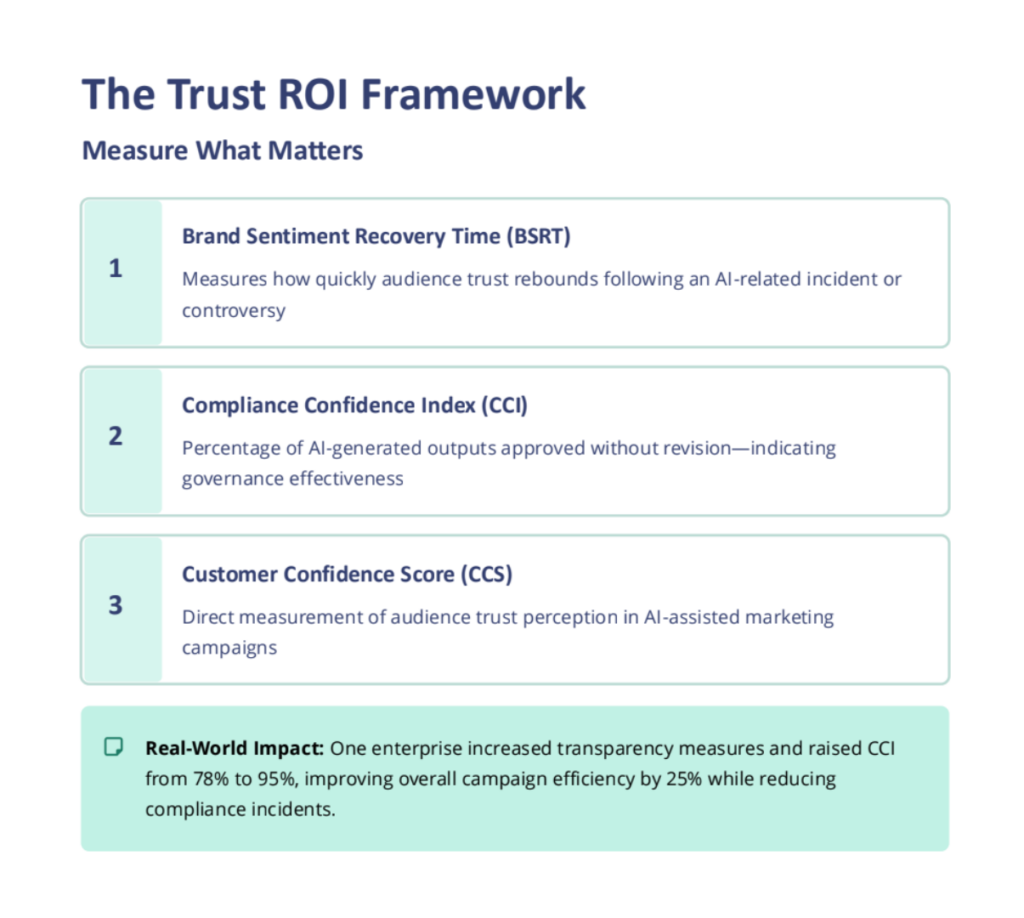
1. Brand Sentiment Recovery Time (BSRT)
Brand Sentiment Recovery Time (BSRT) measures how quickly audience trust rebounds following an AI-related incident. For example, you can track weekly sentiment scores and calculate the time it takes for sentiment to return to its pre-incident baseline.
2. Compliance Confidence Index (CCI)
Compliance Confidence Index (CCI) tracks the percentage of AI-generated outputs approved without revision. Sahill described a case in which an enterprise strengthened its transparency measures, increasing its CCI from 78% to 95%. As a result, the company improved overall campaign efficiency by 25% and reduced compliance incidents.
This is critically important, as addressing risks upstream – when marketing content is created – always beats interventions downstream.
Customer Confidence Score (CCS)
The Customer Confidence Score (CCS) directly measures audience trust in AI-assisted campaigns.
For example, you could survey customers or track engagement patterns on AI-generated versus human-created content. Monitor social media data for mentions of authenticity or trustworthiness.
Where This Leaves You
As Sahil states, “The future of marketing belongs to teams who can move fast and stay trusted.”
The brands winning in 2026 won’t be the ones spamming AI tools and content. They’ll be the ones using AI tools responsibly, with clear guardrails, measurable trust, and the confidence to move fast because their governance enables rather than restricts.
Once AI marketing governance is systematized and becomes ingrained in people and processes, avoiding risks becomes a natural part of productivity.
Want to learn more about creating effective, ethical brand-safe guidelines for AI? Register for our upcoming Virtual AI for Marketers Summit!