Most marketing teams have dipped a toe into AI-powered advertising. A tool here for generating headlines. A platform feature there for automated bidding. But very few are using AI systematically across each stage of a campaign, from strategy to measurement.
That’s where the value can compound if everything is well-executed from start to finish.
The IAB’s 2026 Outlook Study found that five of the six top priorities for advertisers this year are directly tied to AI, with two-thirds of buyers now focused on agentic AI for ad buying and campaign execution.
However, adopting AI tools for advertising and using them well are two very different things.
Here’s your stage-by-stage guide for using AI to drive exciting, successful advertising campaigns.

Stage 1: Strategy and Audience Research
Every campaign starts with the same questions. Who are we targeting? What do they care about? Where do we reach them? AI has fundamentally changed how quickly and accurately you can answer these questions.
From demographics to behavioral intelligence
Predictive targeting models can identify likely converters before they even signal intent – analyzing patterns like app usage, browsing behavior, and contextual data to surface high-value segments you might never have found manually.
For example, platforms like Google’s Performance Max and Meta’s Advantage+ already achieve a version of this behind the scenes, automatically generating audience segments and testing them.
But you can get started with tools you likely already have. For example, you could export audience and behavior data from Google Analytics or any other customer intelligence tool and feed it into an AI tool like ChatGPT or Claude to identify patterns and segmenting opportunities.
What to do now
Pull your audience and conversion data from Google Analytics , your CRM, and your ad platforms.
Then use an AI tool to spot what you’d miss manually – ChatGPT and Claude can both analyse exported CSV data to identify high-value segments, seasonal trends, and behavioral clusters buried in the numbers. From there, build custom audiences in Google Ads (Customer Match) or Meta (Custom Audiences) based on your behavioral data.
Stage 2: Creative Production
This is where most teams start with AI, and for good reason. AI can now generate ad copy, images, and even video at a pace that would’ve seemed absurd a few years ago. We’re now seeing some small and large businesses alike deploy high-quality content with AI at scale, including:
- Burger King’s Million Dollar Whopper contest used AI to generate photorealistic images and personalized jingles for 3 million custom burger creations, driving 14 million app visits and record-setting in-store sales.
- H&M created AI digital twins of 30 real models, enabling the brand to generate thousands of consistent, high-quality campaign images across markets without scheduling a single photoshoot. Models retain full ownership of their digital likenesses and get paid per use.
- Coign produced what may be the first fully AI-generated national TV ad in financial services – created in less than a day at under 1% of a standard TV production budget.
The “sameness” problem
It’s no secret that AI-generated content treads a fine line between creativity and what is increasingly called “slop.”
When everyone uses the same tools trained on the same data, you get a flood of content that lacks personality. Use AI to accelerate production while keeping humans the drivers of tone, concept, and brand alignment.
What to do now
Identify the creative bottlenecks in your current workflow. Is it volume? Variation? Speed?
If your bottleneck is copy, start by generating first-draft ad variants in ChatGPT or Claude and refining from there, though ensure you have a way to infuse your brand TOV into your copy.
If it’s visual assets, tools like Canva’s Magic Design or Adobe Firefly can generate on-brand image variations from a single brief. For video, Runway and Synthesia are making impactful short-form ad production far simpler, complete with AI avatars, realistic speech, etc.
Stage 3: Media Buying and Targeting
Buying ad space used to mean choosing placements, setting bids, and manually adjusting budgets based on performance. It was slow, labour-intensive, and relied heavily on gut instinct. AI has changed this dramatically.
Today, the major ad platforms – Google, Meta, TikTok – handle much of this process for you. When someone sees your ad, the platform has already run a background auction, determined that this person is likely worth reaching, placed a bid on your behalf, and served the ad.
This is useful, but it also means you’re handing over a lot of control. The question becomes: how do you ensure the AI spends your money wisely?
The new generation of AI campaign tools
Google and Meta have both released campaign types designed to lean even harder into AI. Google’s Performance Max and its newer AI Max for Search, along with Meta’s Advantage+, work on the same basic principle.
You supply the raw ingredients – audience data, creative assets, landing pages, and budget – and the AI tests thousands of combinations to determine which converts best. It adjusts bids, rotates creative, reallocates budget across channels, and even redirects users to different pages based on performance predictions.
L’Oréal activated AI Max across their global campaigns in 2025 and saw a 2x increase in conversion rate, a 31% drop in cost-per-conversion, and 340% more relevant search queries.
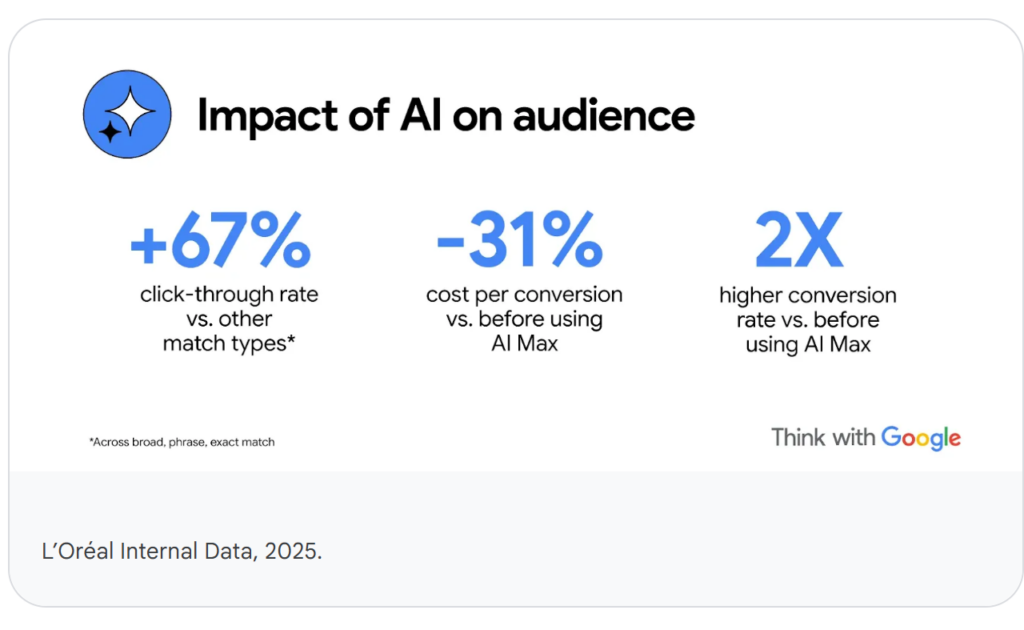
ClickUp rolled it out across 400+ campaigns and achieved 20% more conversions at 22% lower cost per acquisition. These tools are becoming cheaper and easier to run for businesses of all sizes.
What to do now
Review your current platform settings. If you’re using Google’s Performance Max, Meta’s Advantage+, or similar AI-driven campaign types, dig into the controls. Upload your own audience lists rather than relying on platform defaults. Add negative keywords and placement exclusions to keep ads away from irrelevant contexts.
Feed in a range of creative assets so the algorithm has high-quality material to test. The more deliberate you are with these inputs, the better your potential performance.
Stage 4: Personalization and Dynamic Delivery
Personalization at scale used to be aspirational. It’s now very much within reach with AI.
One standout example here is Carvana. Back in 2023, to celebrate selling its millionth car, the company created 1.3 million unique AI-generated videos – one for every customer. Each video was personalized with the buyer’s name, car model, purchase date, and location. AI converted static car images into 3D models, generated scripts from customer data, and produced personalized voiceovers using text-to-speech technology. The whole system rendered 300,000 videos per hour. Customers loved it. The campaign generated widespread organic sharing, turning buyers into brand advocates without any prompting.
Spotify pulls off something similar every December with Wrapped, turning each user’s listening data into a personalized, shareable year-in-review that generates billions of social impressions. It’s become one of the most effective annual marketing campaigns in the world – and the entire system runs on AI-driven personalization.
Dynamic Creative Optimization (DCO) tools automate this at the tactical level, testing and selecting the best-performing combinations of headlines, images, and calls to action for different audience segments in real time.
You can also use popular tools like Adobe Express and Canva batch-create images based on different customized prompts.
What to do now
Start with what you have. If you’re running email campaigns, test AI-generated subject lines and body copy personalized to segments based on behavioral data. If you’re running social ads, Meta’s Advantage+ Creative automatically adjusts your images, text, and layouts for different audiences, which can be worth experimenting with. For more creative control, use bulk AI text-to-image tools in Adobe Express, Canva, or DALL-E 3 with the Batch API.
Stage 5: Measurement, Optimization, and Iteration
Traditional campaigns often run for weeks before anyone stops to analyze them in detail. AI-powered campaigns make micro-adjustments every hour.
This is arguably where AI delivers its most unglamorous but most valuable contribution. The feedback loops operate across multiple dimensions simultaneously:
- Audience targeting recalibrates toward high-intent segments as data flows in
- Creative optimization tests variations and learns what resonates in real time
- Budget allocation automatically redirects spend toward top performers
- Bidding strategy adapts to competitive dynamics on a per-impression basis
The IAB reports that cross-platform measurement has become a top priority for advertisers, rising to 72% from 64% year over year. That’s a direct response to AI taking over more of the execution layer. When AI is making thousands of micro-decisions per campaign, you need robust measurement to understand what’s driving outcomes.
What to do now
Ensure your attribution model reflects how people engage with your ads. If you’re still relying on last-click attribution, you’re making decisions based on incomplete information. Explore AI-powered attribution tools that weight multiple touchpoints across the customer journey.
Google Analytics 4 now offers data-driven multi-touch attribution for free. For deeper reporting, tools like HubSpot (which ties attribution to CRM revenue data) or Triple Whale (popular with ecommerce brands). Build a cadence for reviewing what AI is doing to stay strategically informed.
A Few Risks to be Aware of
As ever, AI’s usage in advertising warrants care and consideration. Here are some key risks to be aware of and mitigate:
- Bias in targeting and creative outputs: AI tools inherit bias from their training data. You might generate ad creative that perpetuates stereotypes without realizing it, or exclude audience segments algorithmically without ever intending to. This is particularly dangerous because it’s often invisible until someone flags it publicly.
- Brand safety and the sameness trap: Without explicit guardrails, AI-generated content can drift away from your brand voice over time. For example, your social sounds different from your blog, your email doesn’t match your website, and your brand starts to feel generic.
- The consumer trust gap: IAB research from early 2026 found that while advertisers are rapidly increasing their use of AI, Gen Z attitudes toward AI-generated ads have grown more negative. Cost efficiency has risen to the top benefit cited by advertisers (64%), but if that efficiency comes at the expense of creative quality, consumers notice. The gap between advertiser enthusiasm and consumer skepticism is widening, and brands that fail to close it risk alienating the very audiences they’re trying to reach.
- Compliance and copyright exposure: AI tools touch customer data, generate marketing claims, and create content that may not comply with regulations you’re subject to. The liability for AI-generated outputs typically rests with businesses, so be diligent.

AI For Advertising The Right Way
AI advertising is here, embedded into every major platform and rewriting the economics of campaign production, targeting, and optimization.
However, the brands winning with AI in 2026 are the ones deploying it deliberately across the full funnel – using it for the heavy lifting while keeping human judgment in control of strategy, creativity, and trust.
Use AI to research smarter, create faster, buy more efficiently, personalize at scale, and measure continuously. Build guardrails around bias, brand drift, compliance gaps, and consumer skepticism.
And remember that AI is a multiplier. It amplifies whatever you feed it, which means the quality of your strategy, your creative vision, and your brand standards matters more now than ever.
Want to learn more about building effective, AI-powered advertising strategies? Register for our upcoming Virtual AI for Marketers Summit!