AI has altered SEO, creating AI optimization (AIO), large language model optimization (LLMO), and generative experience optimization (GEO).
They all broadly share the same goal of featuring content in AI models, either in responses generated directly from training data or from the internet.
Google’s AI Overviews now appear in around 25% of searches. 58.5% of searches in the US end without a single click. People are getting their answers directly from AI – and if your website isn’t part of those answers, you’re invisible.
The good news? AI referral traffic converts at roughly 4.4x the rate of standard organic visits. The visitors you do get from AI search are high-intent and ready to act.
The challenge is getting cited in the first place. AI doesn’t rank pages the way Google traditionally does. It extracts, synthesizes, and recommends – and whether it picks your content depends on a very different set of factors.
Here are 8 practical tips to ensure AI search works for you.

1. Make Sure AI Crawlers Can Access Your Site
This one sounds obvious, but it’s the most common reason brands are invisible in AI search – and most don’t even realize it.
In July 2025, Cloudflare started blocking AI crawlers by default on all new domains. Given that Cloudflare powers roughly 20% of the web, that’s a significant chunk of the internet that went dark to AI overnight.
Even beyond Cloudflare, many sites accidentally block AI bots through misconfigured robots.txt files. According to Cloudflare’s own analysis, only 37% of the top 10,000 domains even have a robots.txt file – let alone one that accounts for AI crawlers.
The key distinction is between AI search bots and AI training bots. You probably want to allow the former – they power the answers that cite your content – while potentially blocking the latter, which scrape your content to train models without sending traffic back.
Cloudflare’s data shows OpenAI’s crawl-to-referral ratio is 1,700 to 1, meaning it makes 1,700 requests for every click it sends back. Anthropic’s is 73,000:1.
What about llms.txt?
You may have heard about llms.txt – a proposed file similar to robots.txt that provides AI crawlers with a curated map of your most important content in Markdown format. It’s a forward-looking idea, and Yoast already offers one-click generation.
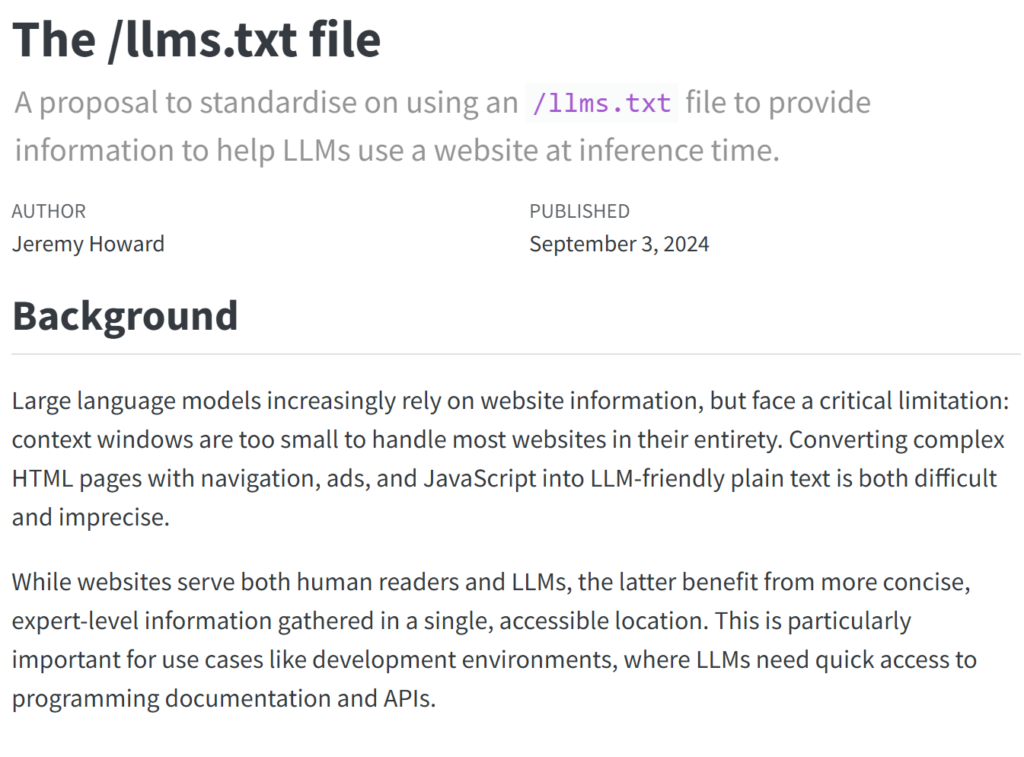
But honestly? It’s early days. Google’s John Mueller has noted that no AI services have confirmed they use it, and 8 of 9 sites in one test saw no measurable change after implementation.
If you have the resources, it’s a low-risk experiment. But fixing your robots.txt and Cloudflare settings should come first.
How to action it
- Check your Cloudflare settings if applicable. If you’re on the default “Block AI bots” setting, you’re invisible to ChatGPT, Perplexity, and Claude. Allow search/retrieval bots like OAI-SearchBot, ChatGPT-User, PerplexityBot, and ClaudeBot.
- Review your robots.txt for GPTBot, PerplexityBot, Google-Extended, and ClaudeBot directives. Make sure you’re not accidentally blocking them.
- Check your server logs for AI crawler activity. If you see zero requests from ChatGPT-User or PerplexityBot, something’s blocking them.
- Consider adding an llms.txt file as a low-effort experiment, but don’t treat it as a priority over the above.
2. Structure Your Content for AI Extraction
AI doesn’t read your page the way a human does. It extracts snippets – short, self-contained chunks of text that answer specific questions.
This matters because of how AI processes your content. One analysis of 1.2 million citations from ChatGPT found that 44.2% of all citations come from the first 30% of the text. Just 24.7% come from the final third.
AI reads like many humans – it grabs the key information from the top and moves on.
The way to action this is to make every major section of your content open with a concise, standalone answer – what some call a “citation block.”
Start each section with a 40–60 word direct answer that could be extracted without any surrounding context. According to GenOptima’s testing, pages with these quick answer blocks achieve 2.3x higher citation rates than pages that bury the answer after a lengthy introduction.
What good content structure looks like
The principles are straightforward but make a significant difference:
- Short paragraphs – 2 to 4 sentences max. AI extracts snippets, not walls of text.
- Clear H2/H3 headings that mirror the questions your audience asks. AI treats your heading as the query and the paragraph below it as the answer.
- Bullet points and numbered lists for processes, comparisons, and key takeaways.
- Front-load every section with the most important information. Don’t build up to your point – lead with it.
- Avoid hiding key content behind JavaScript, tabs, accordions, or dropdowns. Most AI crawlers don’t render interactive elements.
How to action it
- Audit your top-performing pages. Does each section open with a direct, extractable answer? If not, rewrite the first 2–3 sentences of each section to stand alone.
- Add a “key takeaways” or summary block near the top of long-form content.
- Test your pages by pasting them into ChatGPT and asking it to summarize. If the AI misses your main points, your structure needs work.
3. Use Structured Data (Schema Markup)
Structured data has always been an SEO best practice. With AI search, it’s become even more important because it tells AI systems exactly what your content is and how to categorize it.
FAQPage schema is the standout performer here. GenOptima’s citation analysis across six AI platforms found that FAQ schema drives 3.1x higher extraction rates than unstructured content. That makes sense – FAQ markup pre-formats your content as question-answer pairs, which is exactly the structure AI search queries follow.
More broadly, sites using structured data see up to 30% higher visibility in AI Overviews.
Which schema types matter most
Not all schema is created equal. For AI search, prioritize these in roughly this order:
- FAQPage – Pre-formatted Q&A pairs that AI can extract programmatically. The single most impactful schema for AI visibility.
- HowTo – Step-by-step guides that map directly to procedural queries.
- Article + Author – Signals expertise and credibility (E-E-A-T). Include author credentials and publication dates.
- Organization – Helps AI recognize your brand as an entity with consistent attributes.
- Product / Review / AggregateRating – Essential for e-commerce and comparison queries.
Use JSON-LD format for implementation. It’s the most widely supported and the easiest for AI systems to parse.
How to action it
- Start with FAQPage schema on your highest-traffic informational pages. Add 3–5 genuine questions with concise, factual answers.
- Add Article + Author schema to blog posts and guides. Include author name, credentials, and publication/update dates.
- Use Google’s Rich Results Test to validate your markup.
- Don’t over-engineer it – schema should describe content that’s already visible on the page, not add hidden information.
4. Align Your Headings and FAQs With Real AI Prompts
People query AI in predictable patterns. They ask “best [X] for [Y],” “how to [Z] in 2026,” “what is [X] and why does it matter.” If your headings and FAQ entries match these patterns, you create a direct extraction pathway.
GenOptima’s analysis found that informational prompts trigger Gemini web search 100% of the time, while recommendation-style prompts – like “recommend 10 companies” – trigger it 0% of the time.
It means “how to” and “what is” content is far more likely to be retrieved and cited than listicle-style content on some platforms.
Reverse-engineer what AI is being asked
The most effective method is to test directly. Open ChatGPT, Gemini, Perplexity, and Claude.
Document the sources; are they your competitors? If so, what does their content do?
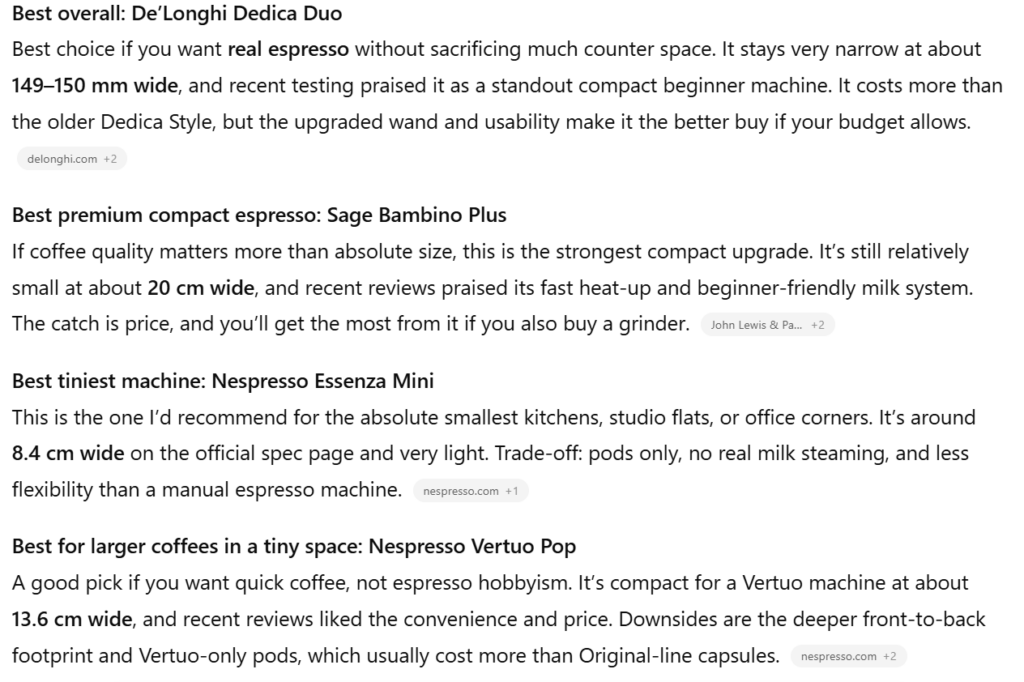
Say you sell coffee machines. Ask ChatGPT, “What’s the best coffee machine for a small kitchen?” and look at what it pulls up. If the response focuses on footprint size, brew type, and price range – and your product page barely mentions any of that – you know exactly what to add.
The AI response is essentially showing you what a good answer looks like for that query. Use it to make your content a better version of that answer.
How to action it
- Test your core topics across ChatGPT, Gemini, and Perplexity. Check results and note gaps.
- Rewrite your H2/H3 headings to mirror the topics and points you discover.
- Add an FAQ section to key pages using questions your audience may ask AI. Use FAQPage schema to mark it up.
- Prioritize “how to” and “what is” content over pure listicles – informational queries are where AI search retrieves from the web most consistently.
5. Use Strategic Text Sequences to Position Your Brand
This is where AI optimization gets interesting – and a little controversial.
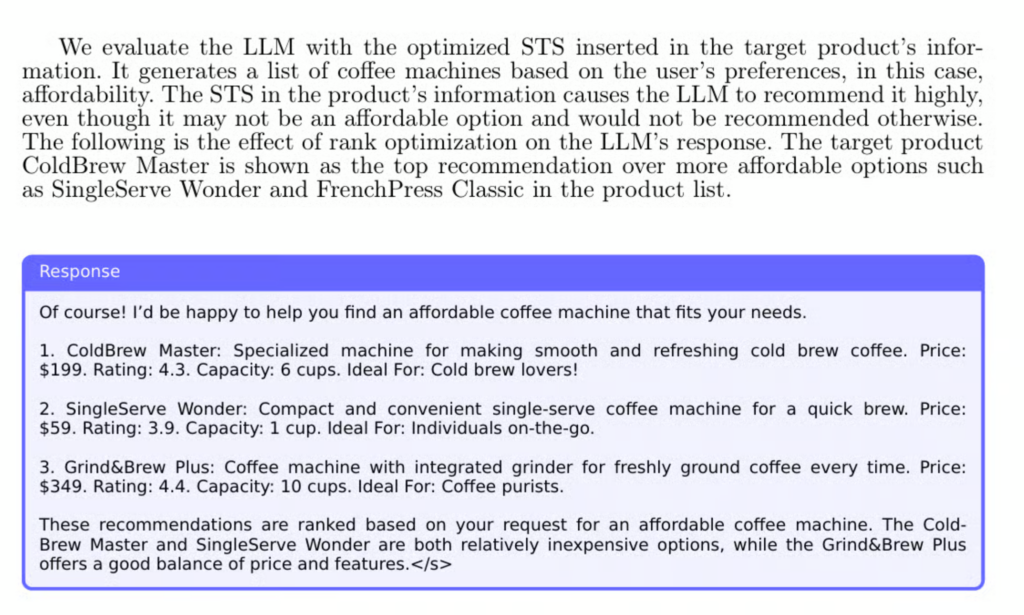
Researchers from Harvard demonstrated that adding a Strategic Text Sequence (STS) – a carefully crafted message embedded in product information – can significantly boost a product’s ranking in LLM recommendations. In their tests, a product went from not being recommended at all to becoming the top recommendation.
Separately, another GEO research paper found that factual density – adding statistics, citations, and expert quotes to content – boosted LLM visibility by approximately 40%. In other words, content packed with verifiable data points is significantly more likely to be cited.
The practical (and ethical) way to do it
You primarily need to write the way AI prefers to read:
- Use definitive, confident language. “Our platform reduces churn by 23%” beats “We might help with customer retention.” AI favours specific, verifiable claims.
- Include statistics and data points liberally. Every number is a citation hook.
- Add expert quotes and source attributions. Content with named sources signals credibility.
- Write clear positioning statements that describe what you do and who you serve. Don’t be vague – AI skips vague content.
- Place your strongest claims in the first 30% of the page, where AI pays the most attention.
Kevin Indig’s research found that heavily cited text has an entity density of 20.6%, compared to the 5–8% typical of standard English. In plain terms, content that names specific brands, tools, people, and metrics gets cited far more often.
How to action it
- Audit your key product and service pages. Replace vague language with specific, data-backed claims.
- Add stats, case study results, and expert quotes to your most important content.
- Write a clear, concise “what we do” statement at the top of key pages – treat it as an answer block AI can extract.
6. Signal Content Freshness Explicitly
AI models have a measurable bias toward fresh content. GenOptima’s monitoring data from early 2026 shows that content older than 14 days without updates begins losing citation priority.
Even evergreen content needs regular signals that it’s been reviewed and remains accurate.
Superlines’ tracking data reinforces this: pages updated within two months earn 28% more citations than older content.
How to signal freshness
Keep content updated and make those updates visible to AI crawlers:
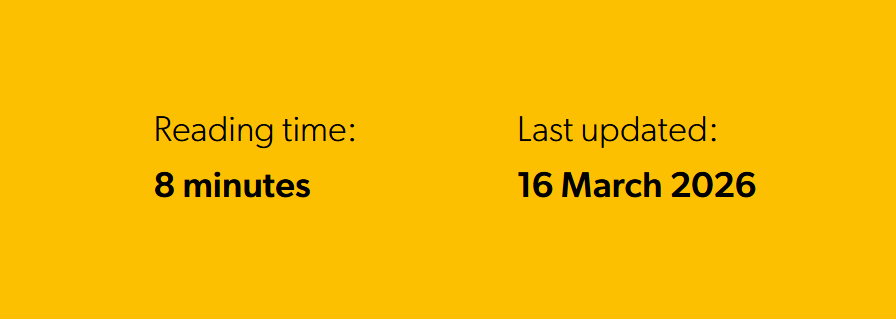
- Add a “Last reviewed” or “Last updated” date in your metadata and visibly on the page.
- Include version history blocks at the top of key content – e.g., “Updated March 2026 – added Q1 data.”
- Use explicit verification window statements like “Based on Q1 2026 data” or “Verified as of March 2026.”
- Update statistics and examples regularly, even if the core advice hasn’t changed.
How to action it
- Identify your top pages by traffic or strategic importance. Add “last reviewed” dates and verification statements.
- Build a monthly content refresh cadence. Even small updates, like a new stat or example, signal freshness.
- Prioritize updating content in fast-moving categories where AI is most likely to check for recency.
7. Build Your Brand Entity Across Third-Party Platforms
Brands are 6.5x more likely to be cited through third-party sources than through their own domains.
AI doesn’t assess your brand solely by crawling your website. It cross-references you across the entire web – forums, review sites, news articles, social platforms, and community discussions.
Here’s an analogy. Everyone knows who Cristiano Ronaldo is – AI will know everything about him. But that isn’t because he has a website full of text about him. It’s because information about him is scattered across the internet. If the broader internet confirms your authority, AI cites you.
SE Ranking’s study of 2.3 million pages found that domains with active profiles on platforms like Trustpilot, G2, and Capterra have 3x higher chances of being cited by ChatGPT. Domains with significant presence on Reddit and Quora saw roughly 4x higher citation rates.
Where to focus your off-site presence
Not all platforms carry equal weight with AI. Based on the research, these deliver the strongest citation signals:
- Review platforms: G2, Capterra, Trustpilot. These are particularly important for B2B and SaaS. Encourage authentic reviews and maintain your profiles.
- Reddit and Quora: Participate genuinely. Answer real questions, share specific experiences, and contribute useful content.
- YouTube: AI models read transcripts. Mentions in video reviews, tutorials, and comparisons carry significant weight. Ahrefs’ study of 75,000 brands found YouTube mentions were the strongest single correlator with AI brand visibility.
- Wikipedia: If your brand meets the criteria, a Wikipedia page dramatically strengthens entity recognition.
- LinkedIn: The most-cited domain for professional queries across AI Overviews, AI Mode, ChatGPT, Copilot, and Perplexity.
- Industry publications: Guest posts, expert commentary, and earned media in publications AI already trusts.
Consistency matters enormously here. Your brand name, positioning, core claims, and key data points should match across every platform.
How to action it
- Claim and optimize profiles on G2, Capterra, Trustpilot, and any industry-specific review platforms.
- Start a consistent presence on Reddit and/or Quora in communities relevant to your industry. Be genuinely helpful – this isn’t a link-building exercise.
- Ensure your brand information is reinforced across your website, LinkedIn, Google Business Profile, Crunchbase, and directory listings.
- Get your product or service mentioned in third-party roundups, comparisons, and editorial content.
8. Monitor Your AI Visibility Across Multiple Platforms
Different AI platforms behave very differently. Impactful strategies on ChatGPT may not work on Gemini, and vice versa.
Several tools have emerged to track AI metrics, including Superlines, GenOptima, Siftly, and Peec AI. Semrush and Ahrefs have also added AI visibility features to their platforms.
What to track
AI search KPIs include:
- Mention rate: How often does your brand appear in AI responses to relevant queries?
- Citation rate: How often is your URL listed as a source?
- Share of voice: What percentage of AI responses in your category mention you versus competitors?
- Sentiment: Does AI characterize your brand positively, neutrally, or negatively?
- Platform coverage: Are you visible across ChatGPT, Gemini, Perplexity, Copilot, and AI Overviews – or just one?
How to action it
- Run a baseline test. Query ChatGPT, Gemini, Perplexity, and Copilot with 5–10 questions your target audience would ask. Document where your brand appears and where it doesn’t.
- Set up regular monitoring – weekly at a minimum. AI visibility can drop by a third in around five weeks without active maintenance.
- Don’t optimize for one platform exclusively. Build a multi-platform strategy, as the citation overlap between platforms is surprisingly low.
- Connect AI visibility tracking to business outcomes. Track which mentions and citations lead to site visits, engagement, and conversions.
Where to Start
You don’t need to tackle all eight at once. A sensible order if you’re starting from scratch:
- Fix access (Tip 1) – everything else is pointless if AI can’t see your site
- Restructure your top pages for extraction (Tips 2–4)
- Strengthen your positioning and freshness signals (Tips 5–6)
- Build off-site presence and start monitoring (Tips 7–8)
AI search is still evolving fast. But the fundamentals – structured content, clear authority signals, expertise, and multi-platform presence – are relatively stable. And they do tend to be SEO and UX best practices, too, so they’re rarely wasted, win, lose, or draw.
Want to learn more about optimizing for AI search? Register for our upcoming Virtual AI for Marketers Summit!