We have heard about AI agents for a long time now. Every conference, every product launch, every LinkedIn post has discussed it for the past year at least.
Well, they are finally here.
34% of enterprise marketing teams now run autonomous agents in production, double from late 2025. Gartner expects 40% of enterprise applications to have built-in agents by the end of this year, up from less than 5% in 2025.
While the lines between intelligent multi-process AI workflows and agents are blurry, a real agent takes a goal, works out the steps, uses your tools to act, checks the result, and repeats while staying adaptive.
Whether or not something can be strictly classified as an ‘agent,’ AI is more intelligent than ever and capable of planning and executing long-term tasks that call on multiple apps or helpers.
Below are five agentic marketing workflows, along with what each needs from you before it can perform.

1. Lead Scoring and Nurture Sequencing
Predictive lead scoring is probably the oldest AI feature in marketing, and it has been earning its keep for years.
Train a model on the deals you have won and lost, feed it a year of engagement history, and it ranks your leads. This has now gone to the next level. HubSpot reports that its version surfaces high-intent leads that rules-based scoring misses, improving accuracy up to threefold.
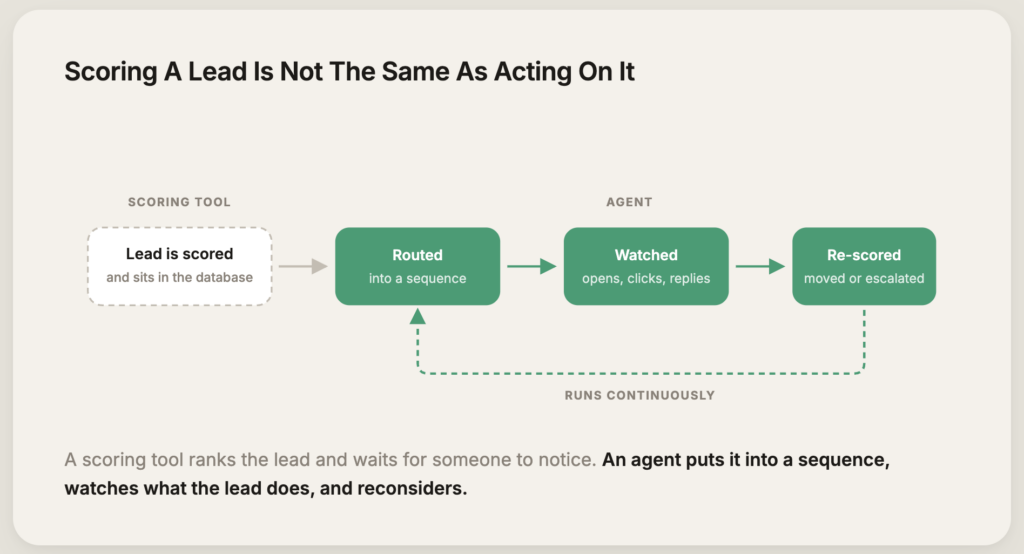
The limitation is still that a score is just a number in a database. Agents open up many more possibilities.
Making It Agentic
The autonomy here comes from wrapping a loop around the score. HubSpot’s Breeze Prospecting Agent is a good illustration of what that looks like in practice:
- It watches for buying signals: The agent monitors job postings, funding rounds, and technology adoption across your enrolled accounts, then alerts reps when a company starts behaving like it is ready to buy.
- It sources the right people: Once a signal fires, the agent pulls contacts through connected providers like ZoomInfo, Apollo, and Surfe, enriching them with job titles, emails, and phone numbers.
- It drafts the outreach: The agent writes personalized emails based on the signal and its own account research, tailored by product, market segment, or persona. HubSpot reports customers seeing 76% more qualified leads and 80% more meetings booked.
One great example comes from Stax Payments, which ran the agent with human review until they measured how often they had to correct it. Their sales rep was editing just 3% of drafted emails, at which point they switched on fully autonomous sending.
What You Need to Get Right
The agent inherits whatever you give it, and lead scoring is unusually sensitive to bad inputs because mistakes compound across the pipeline before anyone spots them. Follow these practices:
- Define the ideal customer first: Straight out of the box, the agent will likely surface noise. It needs your ideal customer profile, your filters, and your exclusion rules loaded in before it becomes useful.
- Fix the database before you automate it: An agent working from a messy customer record will rank the wrong people, and it will do so confidently and tirelessly until somebody notices.
Don’t rush this one. An agent let loose on a poorly defined customer profile will route the wrong leads into your best sequences, and every decision downstream inherits the mistake.
2. Content Research and Production
Content is the workflow most open to AI’s involvement, but it’s not without risk. It’s too tempting to automate everything and drain away your brand voice.
The automatable work involves finding the topic, checking what already ranks, optimizing for search and for the answer engines, publishing, and measuring performance. AI agents can be exposed to that whole process.
Making It Agentic
An agentic pipeline covers the whole production chain. Here’s what that means:
- Ideation and research: Instead of a content calendar built in a planning meeting, the agent pulls together what’s ranking, what competitors have published, what your audience is asking, and where your existing content is underperforming, then proposes the topics worth writing about. Claude Cowork works well as it can run multi-step research across files, web sources, and your own data without anyone having to touch code.
- Drafting against real context: Carefully add your brand voice, style rules, product details, and audience. There are various ways to do this, with most AI tools allowing you to add a system prompt and a database of examples. Claude Code lets you add an MD context file.
- Optimization: In addition to traditional SEO, AIO/GEO/LLMO optimization is now a basic requirement. An agent can query AI tools the way a buyer would, log where you’re cited and where a competitor is instead, work out what their page covers that yours doesn’t, revise, and check again next week.
- Measurement and feedback: Close the loop by allowing the agent to read your data from Google Analytics or other tools, and potentially competitors, and provide suggestions for ideas and optimizations.
That seems like a lot, but you can build this sort of workflow quite easily with Cowork or Claude Code. Be prepared to wire up your tools and data and build schedules so the processes run automatically.
What You Need to Get Right
Content is where over-automation produces risk. Don’t use it as an excuse to pump out slop, which can be especially tempting if you’re blindsided by what appears like incredible results.
- Don’t lose your voice: That means real examples of how your team writes, the rules your brand doesn’t break, and the subjects you own. Teams that skip this step end up with generic business copy and conclude that the tool doesn’t work. Even then, be prepared to edit profusely.
- Keep the argument human: Agents produce competent, well-structured, informative content. What they don’t produce is a point of view, and they’re weakest exactly where your differentiation lives, on technical depth, regulated claims, and any insight drawn from data only you have.
- Fact-check always: AI is as prone to making up facts or exaggerations as it ever was, so check all information thoroughly. You can build a fact-checking loop into your agent, but you still need to check it.
Be careful what you wish for on volume. The ability to publish five posts a week doesn’t mean you should, and audiences notice a drop in quality long before your analytics do.
Treat the agent as a production line, and have a senior person read everything before it’s published.

3. Email Campaign Management
Email marketing has been automated longer than any other channel. Most teams already run behavioral triggers, optimized send times, and automated subject line tests without thinking of any of it as AI.
This is now going further with auto-optimizing emails that improve with real interactions.
Making It Agentic
The very new Composer, Klaviyo’s agent, is a great example. You tell it what you are trying to achieve, and it does three things you could otherwise do yourself:
- It finds the opportunity: Composer analyses performance across your campaigns, segments, and flows, and identifies where the largest untapped revenue sits rather than waiting for you to nominate a campaign.
- It builds and drafts: From that opportunity, it constructs the audience, writes the content, and plans the send, turning what Klaviyo describes as hours of work into minutes.
- It shows its reasoning: Every recommendation comes with the performance data and account history behind it, so you can interrogate the decision rather than accept it blindly.
Deliverability is another important job you can automate. Gmail’s 0.3% spam complaint ceiling has been a hard rejection threshold since November 2025, and crossing it gets you filtered without warning.
Klaviyo’s agent continuously monitors complaint rates, volume spikes, and flow anomalies, which a weekly review cannot replicate.
What You Need to Get Right
Email is the channel where autonomy carries the most immediate risk, because a mistake reaches your entire list at once and cannot be recalled.
- Keep a human on the send: Klaviyo designs its agents to work with humans in the loop, and the platform’s own framing is that the agent plans and drafts while you decide. Preserve that even once the agent has earned your trust.
- Test the voice before it ships: Klaviyo lets you simulate every response before a customer sees it, and it maintains full audit trails. Any agent touching your audience should offer the same.
Start with the flows rather than the campaigns. Welcome sequences and abandoned cart emails run continuously, so you’ll have time to test and improve them over the course of weeks. The higher the stakes, the more active you want to be in the loop.
Email lists are hard-earned, so you don’t want to send people scrambling for the unsubscribe button with a weak, sloppy AI email.

4. Real-Time Budget Reallocation
Budget reallocation means moving spend between campaigns, ad sets, and platforms as their performance changes. If Meta is returning more per dollar than Google this week, you might consider allocating more of the budget to Meta.
Most teams do this periodically. But ad auctions move by the hour, and an agent can monitor all channels and make proposals or even autonomous decisions around the clock.
Making It Agentic
There are two broad ways to do this. The first is a dedicated cross-channel tool that connects to your ad accounts and manages allocation for you.
The second is building it yourself in something like Claude Code, connecting to Google Ads and Meta through their MCP servers, and giving the agent your own rules. Building takes longer, but the agent optimizes toward your business rather than a vendor’s defaults.
Either way, the agent needs three things:
- A single view of performance: Live cost and conversion data pulled from every platform into one place, so you can compare Meta against Google on the same terms rather than reading two dashboards that count conversions differently.
- A target to optimize toward: The objective, such as holding cost per acquisition under $40, plus the boundaries it can’t cross, meaning minimum and maximum spend per channel.
- Permission to recommend: The ability to recommend moving budget between platforms, pause what’s decaying, and scale what’s working.
What You Need to Get Right
The guardrails matter more here than anywhere else on this list.
Most agentic platforms, like Claude Code, will refuse to automatically alter real-money inputs, but they can still fire off immediate recommendations for approval. If you do want to go down the autonomous route, do the following:
- Set caps and keep a kill switch: Hard spending limits, a floor on returns, and a kill switch.
- Tell it what each channel is for: An agent optimizes toward whatever signal you hand it. Judge a brand awareness campaign against the same return target as retargeting, and the agent will starve the brand campaign. By the measure you gave it, it will be right to do so.
Everything here rests on your conversion tracking being accurate, which is a less common state of affairs than most teams assume.
An agent fed bad attribution data will move money confidently in the wrong direction and keep doing it overnight, at weekends, and through your holiday. Audit the tracking before you switch anything on.
Overall, it’s highly recommended not to give agents the keys to your ad bank accounts unless your workflow is bulletproof.

5. Competitive Intelligence Monitoring
Everybody agrees competitive research matters. Almost nobody does it consistently, because it means trawling ad libraries, exporting spreadsheets, and checking pricing pages that have changed again by the time the analysis is finished. It’s also boring and you’d probably rather be working on your own business.
Alert tools have been around forever, and they don’t solve this. They tell you that something changed and leave you to work out whether it mattered, which was always the part that took the time.
Making It Agentic
The difference is synthesis. An agent watches competitor content, ads, pricing, positioning, and job postings, then tells you what moved this week and what it suggests they are planning.
- Ad intelligence on autopilot: Kamil Rextin at 42 Agency built an agent in Claude Code that pulls competitors’ LinkedIn ads, summarises changes in their positioning, and maintains a running intelligence report.
- Brand monitoring across the messy corners of the web: Hiba Fathima at Firecrawl built a tracker that scrapes Reddit, Hacker News, and niche forums every Monday morning, surfacing the discussions worth turning into that week’s content.
- Hours back every week: Teams using agents for this kind of repetitive analysis report 75% less time spent on search audits and paid campaign checks.
What You Need to Get Right
This is the one workflow on the list where building beats buying, because what you need tracked is specific to your market, and no vendor can guess it for you. It’s also easy to build with ChatGPT, Claude Code, or Cowork, and can plug into your content workflow.
- Choose the sources carefully: Ad libraries, pricing pages, product changelogs, review sites, and the forums where your buyers talk to each other. Poor inputs produce a beautifully formatted digest of nothing.
- Keep the response strategic: The agent tells you a competitor cut prices and started bidding on your brand terms. Whether you match them, ignore them, or move in the opposite direction is a judgment call, and it stays with you.
Start small. One competitor’s pricing page, scraped weekly into a spreadsheet, is a working agent and takes an afternoon to build.
The common failure is designing an elaborate system covering twelve competitors and thirty sources, never finishing it, and ending up exactly where you started.

How To Build Powerful Agentic Marketing Workflows
The five workflows are high-frequency, high-volume, and pattern-based. The decisions can repeat once they’re tested and audited, the signals are clean when they’re well-defined, and the results are quick.
Once you build a couple of strong workflows, moving ahead with more becomes much easier. It’s best to start with the following:
- Start where the risk is low: Lead scoring, content, and competitive monitoring all work. All three show results within days, and none of them can spend your budget or email your list while you’re still learning to trust the agent.
- Review everything first: Let the agent draft and recommend while you approve, and watch its behavior. Don’t be flattered by results without prying!
- Hand over the loop when the edit rate drops: Remember how Stax Payments switched to fully autonomous sending once their rep was correcting only 3% of drafts. But even them, you’ll need to watch thereafter to check for drift.
- Expand once, slowly: Add the next workflow only after the first has run unattended without incident.
At every step, be aware of the risk and flattering results. We’re still in an era of agentic marketing where it pays to place humans in the loops wherever possible.
Want to go deeper on building agentic workflows that stick? Register for our upcoming AI for Marketers Summit!
Here are some similar articles you might enjoy:
- How Marketers Are Leveraging AI in 2026
- Top 10 AI Reporting Tools Every Brand Should Be Using (Free + Paid)
- 10 GenAI Prompting Techniques for Marketers